
How to Tell if Your Tarantula is Hungry or Stressed: A Feeding Behavior Guide Featuring the Chilean Rose Hair
Published on: April 9, 2026 | Last Updated: April 9, 2026
Written By: Arlo
Tarantulas, from the dusty pink Grammostola rosea to the bright orange OBT, speak a silent language of posture and movement that reveals their inner state. In my two decades keeping everything from docile ‘pet rocks’ to hair-flicking giants, I’ve seen how misreading hunger cues can lead to overfeeding or unnecessary stress. This guide will help you interpret the subtle signs. The most reliable hunger signal is a tarantula parked at the enclosure front, body lowered and front legs slightly elevated, in a patient ‘ready’ stance.
Quick Stats for the Chilean Rose Hair (Grammostola rosea):
- Origin: Arid scrublands of Chile
- Type: New World, terrestrial
- Growth Rate: Exceptionally slow; a mature female like my Rosie can live over 20 years
Learning this behavioral vocabulary will let you provide precise, stress-minimizing care that supports your spider through every life stage.
Decoding the Basics: Hunger vs. Stress in Tarantulas
Interpreting your tarantula’s behavior begins with a fundamental shift in perspective. You must learn to read a language of stillness and sudden motion, where a raised leg can mean either “I’m ready to eat” or “stay back.” In my years with Rosie, Goliath, and Flash, I’ve seen how easily these states can be confused by a new keeper. Tarantulas also communicate through subtler signals like stridulation, leg tapping, and specific postures. Understanding whether these signals mean threat, curiosity, or calm takes careful observation and time.
Hunger is a drive for resource acquisition, while stress is a reaction to perceived threat. A hungry tarantula is often purposefully alert, while a stressed one is defensively agitated. The key is context: time since last meal, species temperament, and recent enclosure changes.
Consider my Burgundy Goliath Bird Eater, Theraphosa stirmi. When Goliath is hungry, he methodically patrols the moist substrate; when stressed, he immediately kicks clouds of urticating hairs at the slightest disturbance. That stark contrast is your guide.
- Typical Hunger Indicators: Increased evening activity, resting at the enclosure front, a focused attention on movement outside the glass.
- Clear Stress Signals: Rapid retreat to a hide, a defensive pose with front legs and fangs raised, excessive webbing to block visibility, or hair flicking.
My Chilean Rose Hair, Grammostola rosea, exemplifies the need for patience. Rosie’s famous “pet rock” phases, where she refuses food for months, taught me that a fasted, content tarantula is simply calm, not stressed. Mistaking one for the other leads to overfeeding or unnecessary worry.
Clear Signs Your Tarantula is Hungry and Ready to Feed
An eager tarantula broadcasts its intentions through observable changes in routine and posture. The shift from a reclusive dweller to an active predator is one of the most fascinating routines to witness in captivity. These signs are your green light to offer food.
- Patrolling Behavior: Instead of staying in its hide or usual spot, the tarantula walks the perimeter of the enclosure, often at night.
- Positioning at the Ambush Point: It will sit at the entrance of its burrow or web tunnel for hours, perfectly still but visibly alert.
- Rapid Response to Vibrations: A gentle tap on the glass or a feeder insect’s movement triggers an immediate, oriented turn of the body.
- Investigation of Dropped Items: It will quickly approach and tap with its pedipalps when anything, even a dropped water droplet, lands on the substrate.
With my Orange Baboon Tarantula, Pterinochilus murinus Flash, hunger transforms his entire enclosure. His dense, silken webbing acts as a sensory net, and his body tenses visibly at the faintest vibration, a prelude to his lightning-fast strike. This is vastly different from the frantic, continuous webbing he does when rehoused and stressed.
Spotting the Hunting Stance: Posture Tells the Story
The hunting stance is the definitive sign of a tarantula in feeding mode. This is a posture of pure potential energy, the spider’s body coiled like a spring against the substrate. It is a silent, focused pose I’ve seen in all my tarantulas, from the slow Rosie to the rapid Flash.
Look for a specific alignment: the first two pairs of legs are raised and slightly splayed, ready to lunge and pin. The rear legs are tucked and braced, providing the power for a sudden forward thrust that is breathtaking in its speed. The carapace often tilts down, bringing the fangs closer to the ground.
Pay close attention to the pedipalps and front legs. In true hunting stance, you may see tiny, rhythmic tapping or vibrating motions as they test the air and ground for chemical trails. This is the quiet before the storm.
- Freeze and Track: The tarantula becomes utterly still, then pivots its entire body to follow the prey’s movement.
- The Lunge: A explosive forward movement, often covering several inches, to subdue the feeder insect.
- The Pin and Bite: Immediate immobilization with the legs, followed by a precise bite.
I once observed Goliath hold a perfect hunting stance for 45 minutes before taking a roach. Recognizing this patient, poised posture allows you to offer food confidently, satisfying their instinct and minimizing the time prey wanders the enclosure to reduce spider stress. Always drop feeders in gently with long tongs to avoid startling your tarantula and to respect the “Look, Don’t Touch” philosophy.
Unmistakable Red Flags: Stress Behaviors During Feeding
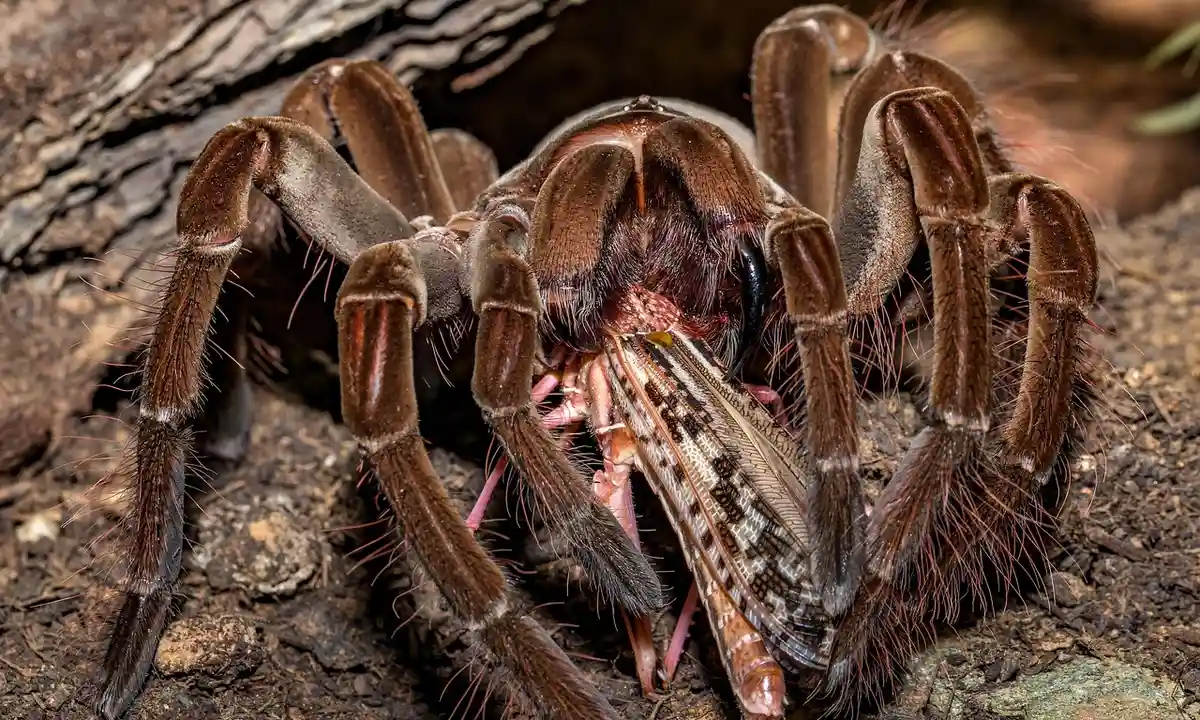
Feeding time is a window into your tarantula’s world. While a successful strike is thrilling, the reaction to food can also broadcast clear distress signals. Recognizing the difference between a wary predator and a terrified animal is fundamental to ethical, stress-free care. I’ve learned this firsthand after a too-hasty cricket drop sent my OBT, Flash, into a threat posture that halted the feeding attempt entirely.
Defensive Posture vs. Hunting Stance: A Critical Comparison
These two positions are polar opposites in meaning. Misreading them can lead to a missed meal or, worse, a stressed tarantula.
| Hunting Stance (“I’m hungry”) | Defensive Posture (“I’m threatened”) |
|---|---|
|
|
If you see a defensive posture during feeding, immediately stop and assess the environment. Other common signs your tarantula is stressed or aggressive include a raised, rigid posture, rapid leg movements, or a threat display. Recognizing these cues helps you respond calmly and avoid escalation. Loud noises, excessive vibration, or a prey item that’s too large and intrusive are common triggers. Remove the prey, give the tarantula complete quiet for at least 24 hours, and try again with a smaller, quieter food item.
When Appetite Fades: Refusal to Eat and Its Causes
A tarantula rejecting food is one of the most common concerns for new keepers. My Grammostola rosea, Rosie, has taught me profound patience, fasting for eight months without a single concern. Refusal is not inherently a problem; it is a message you must decode. Understanding why your tarantula refuses to eat and knowing how to respond is crucial for any caretaker.
Beyond stress, consider these factors for a tarantula that won’t eat:
- Temperature: Metabolism slows below 70°F (21°C). Ensure ambient temps are 72-80°F (22-27°C) for most species.
- Overfeeding: A fat abdomen means a content tarantula that may fast for weeks. Offer food only once every 1-2 weeks for adults.
- Prey Issues: The cricket may be deceased, too pungent from gut-loading, or simply not moving enough to trigger a feeding response.
- Post-Molt Recovery: Their new exoskeleton and fangs need days or weeks to harden. Never offer food before the fangs are fully black.
The Pre-Molt Shutdown: Why Feeding Stops Before a Shed
This is the most critical cause of fasting. In the weeks leading to ecdysis (molting), internal processes take over. The tarantula is literally preparing to burst out of its own skin, and eating is biologically impossible.
Signs of pre-molt are unmistakable with practice:
- Abdomen darkens and appears glossy as the new skin forms beneath.
- A bald spot on the abdomen, often from kicking hairs, may become noticeably darker.
- They seal themselves in their hide or web up their burrow entrance.
- All interest in food vanishes. They may even threat-posture at a cricket.
During this time, your only jobs are to ensure a water dish is full and to maintain slight humidity—around 70-80% for moisture-dependent species like *Theraphosa stirmi*, and simply a water dish for arid types. Attempting to feed a tarantula in pre-molt is a profound stressor and can lead to a failed, fatal molt. Trust the process. Their body knows what it’s doing. Think of this as essential pre-molt tarantula care: steady humidity, minimal stress, and a calm environment set the stage for a successful shed. These conditions help your tarantula complete its molt smoothly when the time comes.
Optimizing Your Feeding Routine for a Calm, Hungry Tarantula
A predictable feeding schedule transforms a potential stressor into a calm ritual. Your tarantula’s hunger cues become obvious when you establish a consistent rhythm that matches its natural metabolism. With my old Chilean Rose Hair, Rosie, I learned her lengthy fasts were normal; offering food weekly only stressed her. That’s part of the best diet and feeding schedule for a healthy tarantula: adjust prey size and feeding frequency to its age and species. Consistency, not quantity, keeps digestion smooth and stress low.
Prey Selection: Size and Type Matter
Offering inappropriate prey size is a common source of feeder stress. The prey item should be roughly the same size as your tarantula’s carapace, not its entire body. I give my Burgundy Goliath Bird Eater, Goliath, an adult dubia roach, but for my fast OBT, Flash, a medium cricket prevents unnecessary chase in his web.
- For slings: Pinhead crickets or pre-killed mealworm segments.
- For juveniles: Live crickets or roaches that cannot overpower the tarantula.
- For adults: Larger roaches, superworms, or the occasional locust for variety.
Dial in the Perfect Feeding Frequency
Species and age dictate how often to offer food. Overfeeding accelerates growth unnaturally and can lead to fatal abdominal ruptures, especially after a molt. My Theraphosa stirmi, Goliath, eats weekly at four years old, while my Grammostola rosea, Rosie, may refuse food for eight months without issue.
- Fast-growing, high-metabolism species (e.g., Psalmopoeus, Theraphosa): Offer food every 5-7 days for juveniles.
- Slow-growing, arid species (e.g., Grammostola, Aphonopelma): Offer food every 10-14 days for juveniles, every 3-6 weeks for adults.
- Always remove uneaten live prey within 24 hours. A cricket can injure a molting tarantula.
Execute a Low-Stress Feeding Technique
Approach the enclosure calmly and use long, smooth-tipped tongs. The sudden strike of a hungry tarantula is a lightning-fast event you should observe, not interrupt. I drop prey near my OBT’s web tunnel and step back, avoiding vibrations that make him defensive.
Never dangle prey directly in front of your tarantula’s fangs. Gently placing the prey on the substrate allows for a natural hunt and prevents defensive bites triggered by perceived threat. Tarantulas are ambush predators that hunt and capture their prey with a swift bite. I learned this after startling my rose hair into a threat posture with clumsy tongs work.
Beyond Feeding: Ongoing Stress Cues in the Enclosure
Chronic stress whispers through behavior and enclosure conditions long after feeding ends. Your daily observation is the best tool for spotting subtle shifts in your tarantula’s well-being. Identifying and preventing health issues is crucial for maintaining that iridescent sheen of a healthy carapace.
Read the Behavioral Alphabet
Normal resting and abnormal stress look different. My T. stirmi, Goliath, kicks urticating hairs at the slightest disturbance when his humidity drops, a clear signal for me to adjust the misting schedule. Compare this to my OBT, Flash, whose intense webbing is natural habitat construction.
- Chronic wall-climbing or pacing: Often signals an enclosure that is too small, too barren, or has incorrect temperature gradients.
- Spending all time huddled in a water dish: Can indicate mite infestation or critically low humidity.
- Excessive burrow sealing: In an otherwise open species, this may mean the tarantula feels exposed and unsafe.
Audit the Enclosure Parameters
Substrate, humidity, and ventilation form the foundation of security. Each species has a non-negotiable humidity range; for example, arid G. rosea suffers on damp substrate while tropical T. stirmi thrives at 80-85%. I keep Rosie’s substrate powder-dry and Goliath’s packed with moisture-retaining sphagnum moss.
| Stress Cue | Common Husbandry Cause | Corrective Action |
|---|---|---|
| Tarantula avoiding half the enclosure | Temperature spike or draft from one side | Relocate enclosure, use a thermostat |
| Refusal to use provided hide | Hide is wrong size or material | Offer a snug, dark cork bark retreat |
| Substrate constantly bone-dry for a moisture-loving species | Inadequate watering routine | Add a larger water dish and overflow it weekly |
The Molting Process Reveals Cumulative Stress
A problematic molt is rarely an isolated event. Successful ecdysis requires perfect humidity and zero disturbance in the preceding weeks. I increase moisture for Goliath as his abdomen darkens, ensuring a clean split. A tarantula struggling for hours in its old skin is showing the result of prolonged environmental stress.
Post-molt is the most vulnerable time. Absolute quiet and no feeding for 7-10 days allows the new exoskeleton and fangs to harden completely, preventing catastrophic injury. I mark my calendar after each molt to avoid the temptation of offering food too soon.
Common Questions
What is the difference between a hunting stance and a defensive stance?
A hunting stance is a posture of focused predation, with the body low and front legs poised to feel for prey. A defensive posture is a reaction to threat, with the front legs and fangs thrown high in the air. The hunting stance is forward-oriented and calm, while a defensive stance signals alarm and readiness to fight or flee.
How does pre-molt behavior affect feeding cues?
Pre-molt behavior will cause all normal hunger cues to completely disappear. Your tarantula will often seal itself away and may even threat-posture at offered food. Attempting to feed during this time is a major stressor and should be avoided until well after the molt is complete. This matches our guide on when not to feed your tarantula, covering pre-molt and other fasting periods. By sticking to these windows, you reduce stress and support healthier molts.
What are the signs of a stressed tarantula during feeding?
Signs include immediately assuming a defensive posture with raised fangs, rapid retreat from the prey, or hair-flicking. A stressed tarantula perceives the feeder as a threat, not food. If you see these behaviors, you should stop the feeding attempt and remove the prey item. It’s crucial to recognize when a tarantula is ready to eat compared to when it’s stressed.
How can you tell if a tarantula is refusing food due to stress?
A stress-related refusal is often accompanied by other clear stress signals like hiding, threat postures, or excessive webbing. If the tarantula is otherwise calm, alert, and not in pre-molt, a simple lack of interest in food is more likely due to being well-fed or environmental factors like low temperature. By learning to read your tarantula’s body language, you can spot stress and defensive signs early. This helps you interpret cues more accurately and respond appropriately.
What are common stress behaviors to look for in a tarantula’s enclosure?
Chronic stress behaviors include constant wall-climbing or pacing, spending excessive time in the water dish, and persistently sealing its hide. These often point to husbandry issues like incorrect humidity, temperature extremes, an enclosure that is too small, or a lack of a proper, secure hide.
The Art of the Wait
When in doubt, let your tarantula teach you its language; the single most important husbandry skill is learning to read the unique, individual patterns of appetite and retreat. My fifteen-year-old Rosie has taught me more about patience than any other creature, her months-long fasts a lesson in trusting the process over the calendar.
Watch for the iridescent sheen of a well-hydrated spider and the silent confidence of a good stance. The real joy comes from seeing a content tarantula engage its world-sculpting dirt into a deep burrow, laying down silken trip lines, or positioning itself for a sudden, precise strike. Each of my spiders, from the defensive Flash to the hair-flicking Goliath, has rewritten my expectations on their own terms. Your greatest tool is not the feeder tongs, but your own quiet observation.
Further Reading & Sources
- Tarantula Feeding – What, when, and how much to feed | Tom’s Big Spiders
- Tarantula Feeding Guide: Tips & Diet Essentials
- How To Create A Tarantula Feeding Schedule
Arlo is a lifelong arachnid enthusiast who believes tarantulas are the world’s most misunderstood roommates. With years of hands-on experience in tarantula care, habitat setup, and species behavior, Arlo combines expert knowledge with a dash of humor to make spider ownership less scary and a lot more fascinating. From choosing the right enclosure to understanding why your eight-legged buddy is doing that weird little pose again, Arlo is here to help you become the best tarantula parent you can be, without getting tangled in the web of misinformation.
Understanding Tarantula Behavior