
What’s the Difference Between Tarantulas and Other Spiders?
Published on: January 5, 2026 | Last Updated: January 5, 2026
Written By: Arlo
Tarantulas are not just large spiders; they are a separate ecological chapter in the arachnid story, defined by unique defenses, decades-long lives, and a quiet presence that common house spiders lack. Having kept everything from the patient G. rosea to the fast-paced P. murinus, I see tarantulas as a distinct hobby that requires a shift in perspective. This guide breaks down the anatomical and behavioral gaps that make tarantula care a specialized practice, far removed from general spider knowledge.
- Quick Stats:
- Family: Theraphosidae
- Size Range: 4 to over 12 inches in legspan, as seen in giants like the Burgundy Goliath
- Lifespan: Years to decades for females, unlike the seasonal cycles of most spiders
- Key Identifier: Presence of urticating hairs on the abdomen in New World species
Understanding these core differences will shape how you approach enclosure design, feeding, and the overall philosophy of ‘look, don’t touch’ husbandry for your tarantula.
Taxonomy: The Family Tree of Tarantulas
To understand a tarantula, you must look at its place in the natural world. All tarantulas belong to the scientific family Theraphosidae, which sits within the vast order Araneae-the true spiders. This means every single tarantula is a spider, but the reverse is not true. The common house spider or the elegant orb weaver in your garden belongs to entirely different families. This taxonomic distinction is the root of every physical and behavioral difference that makes tarantula care a unique niche within arachnoculture.
Think of spider families like different branches on a very large, very old tree. While they share a common trunk (being spiders), their evolutionary paths diverged long ago. The Theraphosidae branch grew in a direction that favored size, longevity, and, in the Americas, a fascinating defense mechanism of barbed hairs.
| Classification Level | Tarantula (e.g., Goliath) | Typical House Spider (e.g., Cellar Spider) | Why It Matters for Care |
|---|---|---|---|
| Order | Araneae (Spiders) | Araneae (Spiders) | Confirms shared basic biology (eight legs, fangs, silk). |
| Family | Theraphosidae | Pholcidae or Theridiidae | This is the critical split. Defines lifespan (years vs. months), size, and primary behaviors. |
| Key Traits | Long lifespans, urticating hairs (New World), large size, two-lung system. | Short lifespans, often intricate webs, small size, diverse hunting strategies. | Dictates enclosure size, humidity needs, and safe interaction protocols. |
The diversity within Theraphosidae itself is staggering, encompassing nearly a thousand described species. From my dusty pink Grammostola rosea Rosie to my lightning-fast Pterinochilus murinus Flash, the range of care needs within just one family shows why genus and species-level knowledge is non-negotiable. Other spider families may have more species, but few offer the same dramatic variety in form and habit for the dedicated keeper.
Size and Physical Traits: Giants with Hair
Scale is the first undeniable difference. A tarantula’s leg span is measured in inches, not fractions of an inch. My Burgundy Goliath Bird Eater (Theraphosa stirmi), for instance, has a diagonal leg span pushing ten inches-the size of a dinner plate. Her body mass is substantial; you feel the weight when rehousing her enclosure. Comparing a tarantula to a common spider is like comparing a wolf to a fox; they may be related, but the presence and impact of the larger animal is profoundly different.
The most visually striking feature is their hair, or setae. This is not the fine fuzz of a jumping spider. A tarantula’s coat can be dense, curly, or shimmer with an iridescent sheen. For New World species like those from the Americas, these hairs are a primary weapon. My Goliath will readily kick a cloud of microscopic, barbed urticating hairs from her abdomen when annoyed. These hairs cause intense itching in mammals and are a clear sign to give the animal space.
- Fangs & Pedipalps: Tarantula fangs are large, hinged, and move vertically in a stabbing motion. Their pedipalps (the leg-like appendages near the mouth) are used for sensing, manipulating food, and, in mature males, for sperm transfer.
- Eyes: They possess eight eyes, typically arranged in two compact rows of four on the front of the carapace. While their eyesight is generally poor, this cluster is a quick visual identifier.
- Silk & Spinnerets: They produce silk from spinnerets at the rear of the abdomen, but its use is often for lining burrows, creating molting mats, or trip lines, rather than the intricate prey-catching webs of other families.
During Goliath’s last molt, I carefully measured the shed exuviae. Laying the crisp, hollow carapace next to a ruler was a humbling reminder of her true scale. The sheer physicality of a tarantula-the sound of their feet on cork bark, the deliberate movement of hefty limbs-creates a captive observation experience unmatched by smaller, shorter-lived arachnids. This majestic size, paired with unique adaptations like urticating hairs, defines the respectful, hands-off husbandry approach that responsible keepers champion.
Venom and Defense: Safety for Keepers
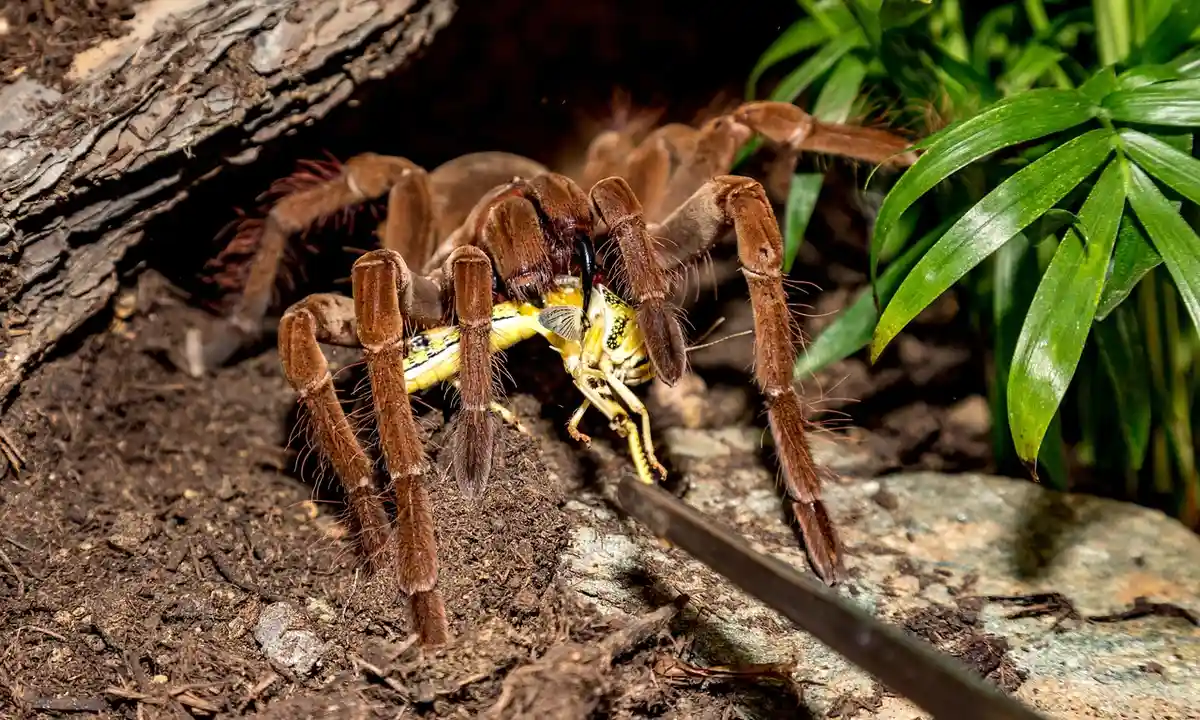
Let’s clear the air on a major point of confusion. For keepers, tarantula venom is almost never a medical emergency. While all tarantulas possess venom to subdue their prey, the vast majority have venom comparable to a bee sting for humans, with effects like localized pain, redness, and itching. This is a stark contrast to the neurotoxic venom of spiders like the Black Widow (Latrodectus), which is considered medically significant, unlike venomous tarantulas that are less harmful.
The real defense you must respect is not the fangs, but the hairs. Most New World tarantulas possess urticating hairs on their abdomen. When threatened, they kick a cloud of these microscopic, barbed hairs toward the threat with their back legs. So which is more dangerous: the hairs or a bite? Generally, the hairs are the bigger irritant, while bites are rare and usually milder.
- The tarantula rears up, exposing its abdomen.
- It uses its hind legs to vigorously brush against the specialized hair patches.
- This releases a cloud of hairs into the air, which can embed in skin, eyes, or respiratory tracts.
Contact causes intense itching, rash, and potentially serious eye or respiratory issues. My Burgundy Goliath Bird Eater (T. stirmi) is a prolific kicker, and I treat its enclosure with the caution of a chemical lab, always wearing gloves and eye protection during maintenance.
Biting is an absolute last resort. A tarantula would rather flee, hide, or posture. A threat posture involves rearing up with front legs and fangs displayed-a clear “back off” signal. My Old World species, like the OBT (P. murinus), prefer a lightning-fast retreat to their silken tunnels.
- Always use long feeding tongs and gentle brushes for cage maintenance.
- Adopt a strict “Look, Don’t Touch” policy. Handling causes immense stress to the animal and offers you no benefit, only risk.
- Work over a large, open bin when performing deep cleans or rehousing to contain any escapes or kicked hairs.
- Wash your hands thoroughly after any contact with the enclosure or its contents.
Behavior and Hunting Styles: Ambush vs. Web
Forget the image of a spider waiting patiently in a geometric orb web. Most tarantulas are ambush predators of the earth and trees. They are patient sit-and-wait hunters, relying on vibration and touch to detect a meal passing by their lair. Other spiders, like orb weavers, are active trap builders, relying on intricate, sticky silk architectures to do the hunting for them.
Tarantulas do use silk, but as architects of their homes, not their dining rooms. They line their burrows with it to stabilize the walls, create silken “trip lines” around an entrance to alert them to movement, and of course, spin elaborate egg sacs. Do tarantulas spin webs? They do produce silk, but not for catching prey like true web-spinning spiders. My OBT, “Flash,” has webbed its entire enclosure into a dense, felted fortress-a common behavior for many Old World and arboreal species.
This leads directly to three core lifestyles that dictate your enclosure design:
- Terrestrial: Ground-dwellers like my G. rosea. They need more horizontal space than height, with a deep, packable substrate for occasional digging and a secure hide.
- Arboreal: Tree-dwellers. They require a tall enclosure with vertical climbing space, cork bark slabs, and anchor points at the top for web construction.
- Fossorial: Obligate burrowers. These species demand a very deep, moist substrate column (often 8-12 inches) to construct their permanent, tunneled homes. They are often seen less, but their underground engineering is remarkable.
Their ambush strategy means tarantulas can and will take down surprisingly large prey relative to their size. A robust terrestrial tarantula can easily subdue an adult cockroach or a couple of crickets. They do not “trap” prey with webs; they feel its footsteps, emerge with shocking speed, deliver a subduing bite, and then retreat to consume their meal in the safety of their hide. It’s a powerful, primal display of patience and precision you simply don’t get from a web-spinner.
Life Cycle: Molting, Lifespan, and Reproduction
The Arduous Renewal: Molting (Ecdysis)
Molting is not simply growth. It is a total physiological reboot. Your tarantula rebuilds its entire body from the inside out. The signs are unmistakable. A once-active spider becomes a statue. Its colors turn dull and dark. The abdomen often appears shiny and black. This sometimes raises concerns about health, prompting owners to wonder if the tarantula is molting or dying.
Recognizing the pre-molt shutdown is your first duty in responsible care-it means no feeding, no handling, and absolute peace.
The process itself is a silent, vulnerable ballet. The spider flips onto its back, a posture that alarms new keepers. It then works to split the old exoskeleton and slowly, meticulously, extracts itself. The new body is soft, pale, and incredibly fragile. This is the most dangerous hours of its life.
- Post-Molt Care is Critical: Do not offer food for at least a week. Its fangs are soft as wax. Ensure water is available. Do not disturb the enclosure for a full week as its new exoskeleton hardens.
- The Great Fasting: Many species, like my old Chilean Rose Hair, Rosie, will refuse food for months before a molt. Her last fast lasted six months-a test of my patience, but her successful shed was the reward.
A Measure in Decades: Exceptional Lifespans
This is a profound difference. While most common house spiders live a single season, a female tarantula’s life is measured in human years. My Grammostola rosea is 15. Many Brachypelma species regularly reach 25 or 30.
Owning a female tarantula is a decades-long commitment, a slow-motion relationship built on observation, not interaction.
Males are the ephemeral counterpart. Upon reaching maturity, their focus turns to romance. They rarely survive more than a year or two after their final molt, a biological clock that ticks far too fast.
Reproduction: A Precise and Perilous Dance
Tarantula breeding is a high-stakes affair. The mature male spins a special sperm web, charges his pedipalps, and begins his quest. The actual coupling is a careful insertion of those pedipalps into the female’s epigynum. For those curious about the full process, a Tarantula mating step-by-step guide outlines the reproduction stages from courtship to fertilization. This helps hobbyists understand what to expect and how to observe responsibly.
The male’s subsequent escape is often as dramatic as the coupling itself, a reminder that in the spider world, reproduction is a lethal gamble.
If successful, the female later creates a silken egg sac, which she guards ferociously. Some species, like my Pterinochilus murinus, will seal themselves in with it. This egg-sac guarding is one of the rare glimpses of parental care in arachnids. After the spiderlings emerge, their journey is solitary and fraught. Only a few from a sac of hundreds may reach adulthood.
Habitat and Care: Applying the Differences
Understanding their biology directly informs their captive environment. You are building a biotope, not just a cage.
Enclosure Design: From Fossorial to Arboreal
Match the enclosure to the species’ natural history-this is the single most important rule for reducing stress and promoting natural behavior.
- Terrestrial/Burrowers (e.g., G. rosea, T. stirmi): Prioritize floor space over height. Provide a deep, damp substrate layer (6+ inches) for burrowing. A fall from even a short distance can be fatal for these heavy-bodied spiders.
- Arboreal (e.g., Avicularia spp.): Vertical space is key. Provide cork bark or other structures for web-tube creation. Cross-ventilation is non-negotiable to prevent stagnant air.
- Opportunistic Burrowers/Fast Terrestrials (e.g., P. murinus): My OBT, Flash, needs both anchor points for dense webbing and a starter burrow. I provide a deep, dry substrate and a tilted cork slab. He does the rest, creating a labyrinth of silk.
Climate Control: Humidity and Temperature
Generalizations fail here. Research your species’ point of origin.
- Arid Species (G. rosea): Dry substrate with a water dish. Ambient room humidity is fine. I keep Rosie’s enclosure bone-dry with a small damp corner only during her pre-molt phase.
- Tropical Species (T. stirmi): My Goliath requires 75-85% humidity. I achieve this with deep, moisture-retentive substrate (a mix of coco fiber, peat, and vermiculite), a large water dish, and careful partial misting. Stagnant wetness kills; moist substrate with ventilation is the goal.
- Temperature: Most species thrive at 70-80°F (21-27°C). Heat mats are dangerous if placed under the tank. Use a space heater to warm the room, not the enclosure directly.
Feeding and Observation
Prey size should be no larger than the tarantula’s abdomen. I feed my adults one large cricket or roach per week. Juveniles get smaller prey twice a week.
Recognize refusal: a tarantula in pre-molt, stressed, or simply not hungry will often ignore or threat-posture at prey. Remove uneaten live prey to prevent injury to your spider.
My OBT rarely refuses. My Rose Hair refuses for months. Learning your individual’s rhythm is part of the craft.
The Foundation: Stress Reduction
Every choice should minimize panic. Provide a secure, snug hide. Use long tongs for maintenance. Limit enclosure traffic to feeding and watering. Vibrations are their primary warning system-a gentle approach prevents bolt reactions.
I learned this when rehousing Goliath; a sudden shadow caused a hair-flicking storm. Now, I work slowly, under dim light, and the process is silent and smooth. The enclosure should be a private sanctuary, a window into a calm and secret world.
Old World vs. New World: A Critical Distinction
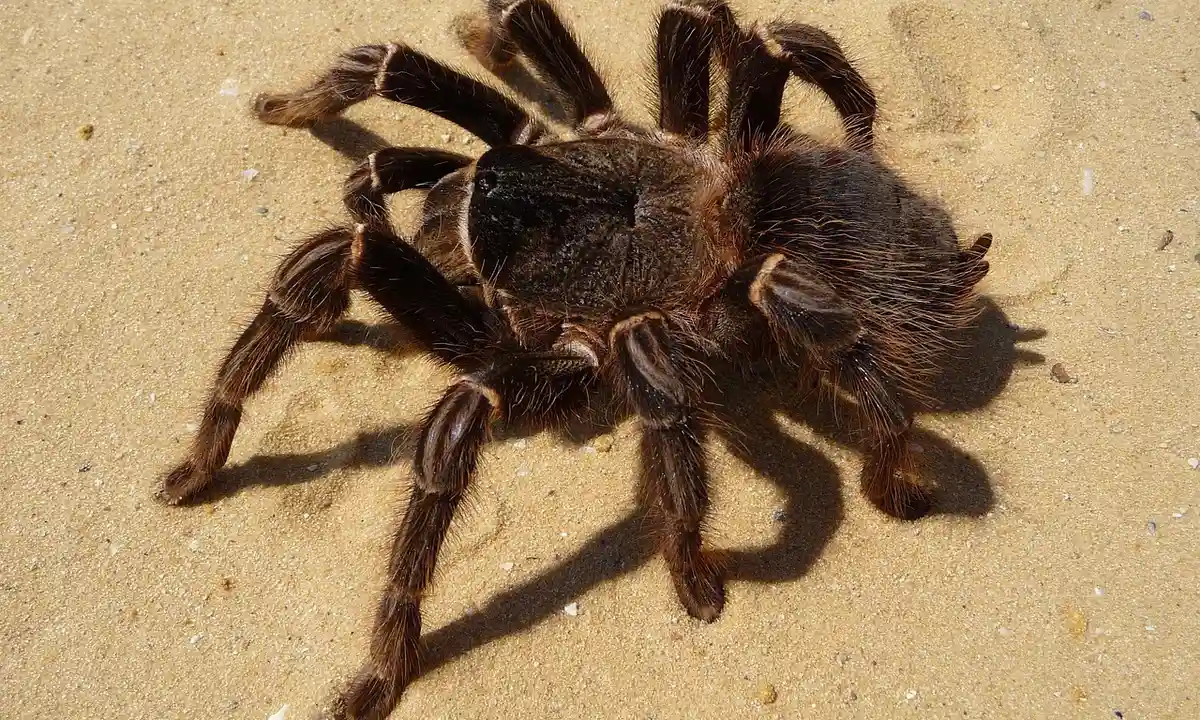
Geography is destiny in the tarantula hobby. This single factor shapes everything from their defense mechanisms to their husbandry needs.
Where They’re From
New World tarantulas hail from the Americas, from the southern United States down through South America. My Grammostola rosea, Rosie, is a classic Chilean example. Old World species come from Africa, Asia, and surrounding regions, like my Pterinochilus murinus, Flash, from Africa.
A Tale of Two Defenses
This split defines their survival strategies. New World tarantulas primarily defend themselves with urticating hairs—specialized bristles on their abdomen they kick into the air. These cause intense irritation to skin and eyes. My Burgundy Goliath, a New World giant, will readily kick a cloud of hairs if disturbed, a far more common reaction than a bite. Understanding the real risks helps keep people safe. The hairs can irritate skin and eyes, and allergic reactions are possible in sensitive individuals.
Old World tarantulas lack these hairs. Evolution armed them instead with potent venom, incredible speed, and a far more defensive posture. They rely on threat displays and lightning-fast strikes. Do tarantulas defend themselves with hairs or venom? Old World tarantulas lack urticating hairs, so their defenses rely on venom and threat displays. My OBT, Flash, would much rather flee or assume a high stance than ever kick hairs she doesn’t possess.
Choosing Your First Tarantula
For beginners, New World species are almost universally recommended. Their generally slower speed and less medically significant venom provide a larger margin for error. An Old World tarantula, like an OBT, requires respect, experience, and flawless enclosure security. I learned this the hard way during a rehousing when Flash moved from one hide to another in a blur I could barely track.
| Trait | New World (e.g., G. rosea, T. stirmi) | Old World (e.g., P. murinus) |
|---|---|---|
| Primary Defense | Urticating hairs | Potent venom & speed |
| Typical Behavior | Often docile, prone to flicking hairs | Often defensive, reclusive, or skittish |
| Recommended Care Level | Beginner to Intermediate | Advanced |
| Venom Potency (to humans) | Typically mild, akin to a bee sting | Can be more potent, causing severe muscle cramps |
Myths Debunked: Separating Fact from Fiction
Tarantulas are shrouded in fear and misinformation. Let’s clear the air with facts grounded in daily observation. This article debunks 11 pervasive tarantula myths with insights from expert keepers. Discover what is fact and what is myth.
-
Myth: Tarantulas are deadly to humans.
No tarantula has a venom lethal to a healthy human. For New World species, a bite is often less severe than a bee sting. Old World venom is more significant but not life-threatening. The real risk lies in allergic reactions or secondary infection, not in toxic venom. In myths vs facts about tarantula venom myths vs facts, the danger to humans is often overstated. The reality is that venom is rarely life-threatening; allergies or secondary infections are the main concerns.
-
Myth: They are aggressive hunters.
Tarantulas are ambush predators and reluctant ones at that. They are energy conservators. My Rosie will sometimes ignore a live cricket for days. They strike from their burrow or hide, overwhelming prey with venom, and prefer to avoid any conflict too large to eat.
-
Myth: They make poor pets.
They are exceptional pets for the right person-the observer. They are living art. Their care teaches patience, biology, and respect for a creature utterly unlike us. They are not for holding or cuddling, but for quiet, fascinated study.
Common Misconceptions and Factual Counters
- Misconception: Tarantulas are inherently aggressive.
Fact: Defensive is not aggressive. They react to perceived threats. My Goliath’s hair-flicking is a clear warning sign to back off, not an unprovoked attack. - Misconception: They need complex, decorated tanks.
Fact: Priority is secure space, correct substrate, a water dish, and a suitable hide. A stressed tarantula in a cluttered, oversized enclosure is a greater welfare issue. - Misconception: Handling is a normal part of tarantula care.
Fact: Handling provides zero benefit to the animal and high risk of a fall, escape, or defensive bite. The “Look, Don’t Touch” philosophy is standard in serious arachnoculture. I have never deliberately handled my OBT, and my rose hair has only been moved during essential enclosure cleanings.
FAQs
How do tarantula bites compare to other spider bites in terms of danger to humans?
Tarantula bites are rarely medically significant, with venom often comparable to a bee sting, especially from New World species. In contrast, spiders like black widows or brown recluses have potent neurotoxic or necrotic venom that requires medical attention. For pet keepers, bites are uncommon as tarantulas primarily use urticating hairs or threat displays for defense. Tarantula bites often cause minimal pain and symptoms.
Why are tarantulas so much larger than common house spiders?
Tarantulas evolved in the family Theraphosidae for greater size and longevity, with some species spanning over 12 inches and living decades. This large body mass supports an ambush hunting style and requires specialized enclosures with ample floor space, unlike smaller spiders that thrive in compact, web-based habitats.
What is the key difference between tarantulas and other spiders for pet care?
The primary difference lies in their behavior and lifespan: tarantulas are slow-moving, long-lived ambush predators needing minimal interaction, while many other spiders are short-lived, active web-builders. This dictates a “look, don’t touch” approach, with enclosures designed for burrowing or climbing rather than web maintenance.
Who would win in a fight between a tarantula and a typical house spider?
Due to their size, strength, and defensive tools like urticating hairs or potent venom, a tarantula would likely dominate. However, such fights are irrelevant in pet care, as tarantulas are solitary and should never be housed with other spiders to avoid stress or injury.
How do tarantula fangs differ from those of other spiders, and why does it matter for keepers?
Tarantulas have large, hinged fangs that move vertically to stab prey, unlike many spiders with smaller, horizontal fangs. This affects feeding routines and safety, as their bites can deliver venom efficiently, reinforcing the need for cautious handling with tools during enclosure maintenance.
The Final Molt
Through every step of their lifecycle, tarantulas operate on a different scale. Their care reflects this. While many true spiders thrive in the micro-climates of a home, tarantulas often require you to engineer a specific, stable slice of their native environment. The single most critical parameter to master for any tarantula is ventilation; stagnant, humid air is a far greater threat to their health than imperfect humidity levels.
The true reward of keeping tarantulas comes from quiet observation. Witness the architectural precision of a webbing species like my OBT, Flash, transforming its enclosure into a silken fortress. Marvel at the patient ambush of a terrestrial species like my old Rosie, a master of stillness. Find joy in the process, not just the result. I still pause to watch my T. stirmi, Goliath, perform its methodical, powerful feeding ritual. Success in this hobby is measured in months and years of subtle changes, not daily interactions, and patience is the most valuable tool on your shelf.
Further Reading & Sources
- The Differences Between Spiders and Tarantulas – The Bio Dude
- r/biology on Reddit: Other than the fangs, what’s the difference between a spider and a tarantula?
- Differences between spiders and tarantulas – Arachnifiles
Arlo is a lifelong arachnid enthusiast who believes tarantulas are the world’s most misunderstood roommates. With years of hands-on experience in tarantula care, habitat setup, and species behavior, Arlo combines expert knowledge with a dash of humor to make spider ownership less scary and a lot more fascinating. From choosing the right enclosure to understanding why your eight-legged buddy is doing that weird little pose again, Arlo is here to help you become the best tarantula parent you can be, without getting tangled in the web of misinformation.
Understanding Tarantula Behavior