
Why Do Tarantulas Groom Themselves? An In-Depth Look at Spider Hygiene
Published on: February 12, 2026 | Last Updated: February 12, 2026
Written By: Arlo
To the casual observer, a tarantula grooming itself might look like a simple scratch, but this meticulous ritual is a cornerstone of arachnid health and a window into their well-being. I have spent countless quiet hours watching my own tarantulas-Rosie’s deliberate leg cleaning, Goliath’s careful palps after a meal, Flash’s frantic pre-molt adjustments-and each session tells a story. This article dissects the compelling reasons behind every lick and wipe, transforming a quirky behavior into a sign of a thriving animal. At its heart, grooming is a non-negotiable maintenance routine that keeps a tarantula’s sensitive equipment in perfect working order.
Quick Stats:
- Behavioral Scope: Observed in every tarantula species, from docile New World types like my G. rosea to defensive Old World spiders like the OBT.
- Primary Drivers: Hygiene, sensory organ maintenance, and urticating hair management.
- Common Cues: Often follows feeding, precedes molting, or occurs during periods of low activity.
- Keeper Takeaway: Frequent, calm grooming is a strong indicator of a settled and healthy tarantula in its environment.
This guide will illuminate the specific purposes behind each grooming action, giving you the knowledge to observe this critical behavior with a deeper, more respectful understanding.
The Compelling Science Behind Spider Self-Care
In the arachnid world, grooming is the meticulous process where a tarantula uses its mouthparts and legs to clean its entire body. This is a complex, innate behavior hardwired into their biology, not a sign of enclosure boredom or stress. Observing it offers a window into their fundamental physiology and survival tactics.
- Sensory Maintenance: Tarantulas rely on sensitive hairs covering their body to detect vibrations, air currents, and chemical cues. Grooming removes dust, old molt fragments, and substrate that can dampen this critical sensory input.
- Hydration Control: They often draw their legs through their chelicerae to manage moisture. This can help spread oral fluids for cleaning or aid in water retention, a vital function for species from arid climates like my Grammostola rosea, Rosie.
- Physical Integrity: The ritual ensures joint membranes and the delicate areas around book lungs remain clear of obstructive debris. It preserves their ability to move smoothly and breathe efficiently.
- Pre-Molt Preparation: Grooming frequency can increase before ecdysis. The spider prepares its old exoskeleton for shedding by ensuring it is clean and free of particles that might hinder the delicate molting process.
The Step-by-Step Spider Salon: A Grooming Sequence
- Raising and Flexing Legs: The session typically begins with the tarantula elevating one leg at a time, bending it at the joints to inspect every segment. This silent, focused movement is the first step in their self-audit.
- Dragging Legs Through Chelicerae and Pedipalps: Each leg is meticulously drawn through the fang-bearing chelicerae and the smaller, arm-like pedipalps. I’ve watched my Burgundy Goliath, Goliath, perform this step with deliberate care, his large legs moving slowly through his mouthparts.
- Cleaning the Underside and Spinnerets: The spider will often lower its prosoma to clean its sternum and the delicate spinnerets. This ensures the silk-producing organs are not clogged, which is especially crucial for heavy webbers like my Orange Baboon Tarantula, Flash.
- Wiping the Carapace: Finally, using its pedipalps, the tarantula wipes over the dorsal carapace and abdomen, removing any stray particles. The iridescent sheen of a clean carapace is a sign of a healthy, fastidious animal.
The entire sequence is methodical and ritualistic, a slow dance of maintenance. Species personality greatly influences this pace; my defensive OBT, Flash, grooms with frantic, hurried strokes, while my docile G. rosea, Rosie, moves with an almost meditative slowness.
Grooming as a Survival Tool in Captivity and the Wild
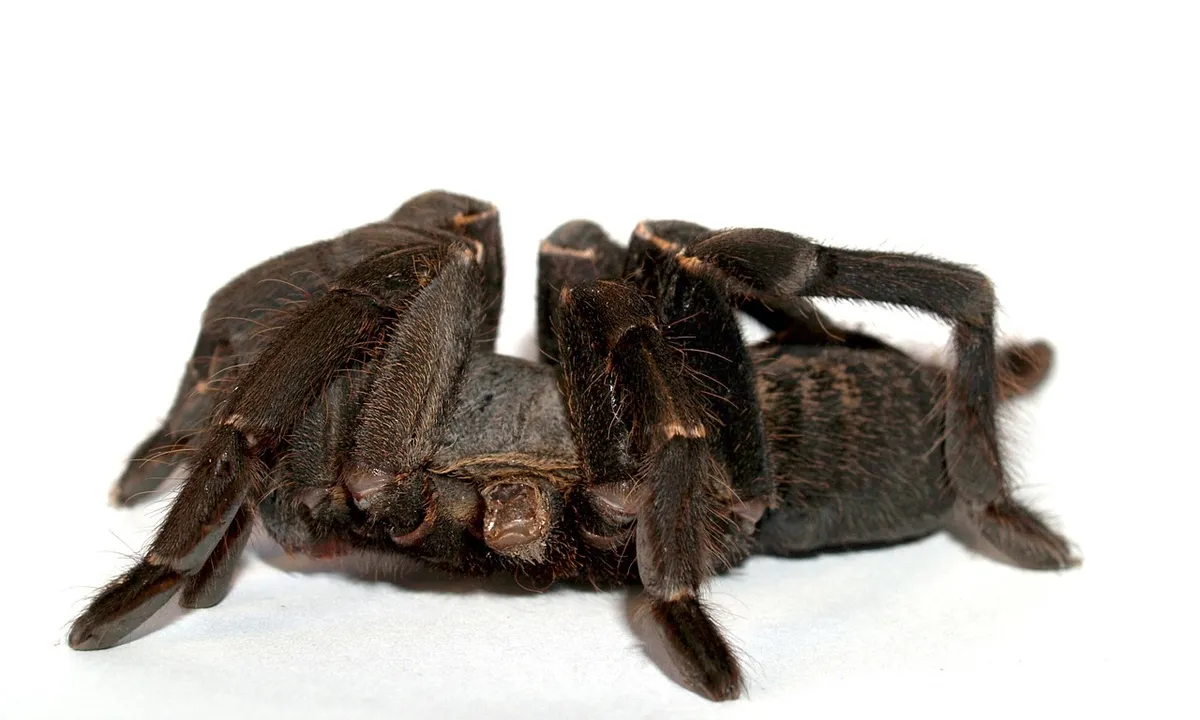
Observing my tarantulas over the years has shown me that every grooming ritual is a non-negotiable part of their health. This self-cleaning is not vanity; it is a series of critical maintenance behaviors that you must account for in their daily care. For beginners, these routines help prevent common health issues like mites and fungal infections. They also support proper shedding and hydration.
- Maintaining sensory hair function: Trichobothria are delicate vibration sensors on their legs and body. When clogged with substrate, their ability to detect prey or your approach is muffled. In practice, use a fine, low-dust substrate like coconut fiber to keep these essential hairs functional.
- Removing old urticating hairs to “reload” defense: My Burgundy Goliath Bird Eater (T. stirmi) frequently kicks hairs, and I’ve seen him groom afterward to shed the spent ones. This is a core reason for “look, don’t touch” handling; stressing your tarantula forces it to waste its primary defense on you.
- Preventing mold and spore buildup: In humid bioactive setups, spores can settle on their exoskeleton. Grooming physically scrubs them away. For keepers, this underscores the need for cross-ventilation in enclosures, balancing moisture with air flow to prevent pathogenic growth.
- Managing hemolymph after a meal: Post-feeding grooming cleans hemolymph-the tarantula’s blood-from their mouthparts. You can support this by removing uneaten prey within 24 hours to reduce bacterial load and cleanup stress.
- Aiding in the molting process: Before ecdysis, tarantulas groom vigorously to separate the old exoskeleton from the new. When you see this pre-molt grooming, immediately stop feeding and ensure humidity is at the species-specific ideal, often 70-80% for tropicals like T. stirmi.
Anatomy of Clean: Key Body Parts Tarantulas Target
Legs and Sensory Hairs
Tarantulas dedicate most grooming time to their legs. Each leg is a sensory array covered in trichobothria, fine hairs that detect the slightest air movement, like a silent alarm system for the enclosure. Debris from damp substrate or fallen frass sticks to them, impairing this vital sense. I keep my substrate slightly dry for Rosie, my G. rosea, to prevent this very issue. Beyond grooming, tarantulas can defend themselves by flicking urticating hairs from their abdomen at threats. Venom serves as a secondary defense if a threat closes in.
Chelicerae, Fangs, and Pedipalps
These are the tools for feeding and manipulation. After the sudden strike and meal, a tarantula will fastidiously clean its chelicerae and fangs, removing prey fluids and old silk to keep them razor-sharp and efficient. My OBT, Flash, constantly gums silk strands off his pedipalps. For your care, offer pre-killed prey of appropriate size to minimize gruesome cleanup and potential injury to these parts. Beyond these tools, using proper tarantula handling safety equipment is essential to protect both you and the spider. Equip yourself with soft-tipped forceps or brushes, a catch cup, and protective gloves to minimize bites and irritation from urticating hairs during handling.
Spinnerets and the Opisthosoma
Clear spinnerets mean unimpeded silk flow for webbing and burrow lining. Grooming here is essential for web-dependent species like P. murinus, who can literally web themselves into a corner if their spinnerets clog. The abdomen, or opisthosoma, is also groomed, especially in New World species. This action manages the patch of urticating setae, keeping them ready for release. Provide a deep, soft substrate to accommodate natural grooming postures without forcing contact with enclosure walls.
Reading the Signs: Grooming as a Health and Stress Barometer
Watching your tarantula groom is a lesson in quiet purpose. Normal grooming is a periodic and calm behavior. You might see your spider pause to carefully clean its pedipalps or brush its chelicerae. It is a routine act of maintenance, often done in the stillness of night.
Frantic, repeated grooming is a deviation from this peaceful norm and a red flag for your attention. I recall once after replacing the water dish for my OBT Flash, his world was disrupted. He retreated, then emerged to groom his legs with a speed and urgency I’d never seen. This was stress grooming, a direct result of the enclosure disturbance.
Excessive grooming can point to several issues. Learn to differentiate the causes.
- Mites: These tiny parasites cause intense irritation. Look for frantic scratching and minute white specks moving on your tarantula’s body or the enclosure walls.
- Chemical Irritation: Airborne sprays, perfumes, or contaminated substrate can coat sensitive hairs. I use only carbon-filtered water in my enclosures to avoid this risk.
- Self-Contamination: After my T. stirmi Goliath kicks urticating hairs, he often grooms his abdomen thoroughly. Those barbed hairs can irritate the spider that shed them.
Your role is to observe without intrusion, letting the tarantula’s behavior guide your husbandry decisions. A five-minute clean is normal; a thirty-minute frantic session is a cry for help.
Species-Specific Styles and Grooming Frequency
Grooming is not a one-size-fits-all behavior. Across my collection, I see distinct styles shaped by ecology and anatomy.
Heavy webbers, like my prolific P. murinus Flash, use silk as a cleaning tool. He draws strands from his spinnerets to wipe down his legs, effectively trapping debris in the sticky webbing. This method is perfect for an arboreal-style web dweller who deals more with airborne dust than loose substrate.
Terrestrial burrowers, like my G. rosea Rosie, have a dustier job. She uses her pedipalps like brushes, meticulously flicking substrate particles from her body and fangs. After even minor digging, she will dedicate time to a full body dust-off. For these pet rocks, grooming is a direct defense against the earthy environment they call home.
Grooming frequency predictably increases during specific biological events.
- Pre-Molt: The process of ecdysis begins internally. As the new exoskeleton forms, the old one can itch, leading to more frequent grooming in the weeks leading up to the shed.
- Post-Feeding: Tarantulas are not neat eaters. Cleaning nutrient-rich hemolymph and prey bits from their mouthparts is a common and necessary ritual.
- After Defensive Acts: Any tarantula that has kicked urticating hairs will likely follow with a careful abdominal grooming session to remove any lingering, irritating setae.
Recognizing these patterns turns simple observation into a powerful diagnostic tool for personalized tarantula care. My Rosie may groom deeply once a week, while Flash incorporates micro-cleans into his constant web-weaving. Their habits are as unique as their personalities.
When Grooming Fails: Risks and Keeper Intervention
Watch your tarantula long enough, and you’ll see the meticulous leg-cleaning, the pedipalp-precision. When this ritual breaks down, health declines fast. Preventing common tarantula health problems starts with vigilant grooming and early detection of issues. By keeping an eye on shedding, appetite, and movement, you can address problems before they escalate. Impaired grooming directly threatens your tarantula’s physiological functions and long-term survival.
The consequences are specific and severe.
- Stuck Molts (Dysecdysis): A layer of dust and debris on the exoskeleton can fuse the old skin to the new. I witnessed this with a rehomed Grammostola rosea; the previous keeper used a dusty substrate, and the spider struggled for days before succumbing.
- Clogged Spinnerets: Silk spigots on the abdomen become blocked. Your tarantula cannot construct shelters, wrap prey, or create egg sacs, leaving it vulnerable and stressed.
- Sensory Deprivation: Specialized hairs (setae) for detecting vibration and chemicals get coated. The world turns silent and tasteless, hindering feeding and navigation.
- Bacterial and Fungal Infections: Open wounds, perhaps from a rough molt, become infected when not kept clean. These infections spread rapidly in the humid microclimate of an enclosure.
Your intervention should focus on prevention, not physical correction. Creating a clean habitat is the most effective medicine you can provide.
Follow these keeper steps to support natural hygiene without contact.
- Guarantee Clean Water Access: Provide a shallow, tip-proof water dish. Refill it with dechlorinated water every two to three days. Hydration aids the molting process and allows your tarantula to ‘drink’ moisture to clean itself.
- Select a Safe, Dust-Free Substrate: Avoid aromatic woods like cedar. I use a blend of coconut coir and sterilized topsoil for most species. Before use, I test it: a handful should hold shape without releasing a visible dust cloud.
- Eliminate Enclosure Contaminants: Never use soaps or chemicals inside the habitat. Spot-clean waste with tongs and plain water. Keep the room free from sprays, perfumes, and cigarette smoke that can settle on surfaces.
Physical assistance is a traumatic last resort. Attempting to clean your tarantula yourself risks lethal injury from falls, ruptured abdomen, or extreme stress. I only consider it during a verifiably stuck molt, and even then, I use a moistened fine brush with surgeon’s caution—a lesson learned from a close call with my old rose hair. When it comes to post-molt care, minimal interference is key.
Supporting Natural Hygiene in Your Tarantula’s Enclosure
Think of the enclosure as a partner in your tarantula’s self-care. The right setup reduces grooming burdens and mimics the cleanliness of a wild habitat. Optimal husbandry makes hygiene effortless for your spider.
Begin with the foundation-your substrate choice dictates moisture and cleanliness.
- For High-Humidity Species (e.g., Theraphosa stirmi): I use a deep layer of coconut fiber for my Goliath. It retains the 75-85% humidity he needs without compacting or molding easily.
- For Arid Species (e.g., Grammostola rosea): A mix of sterile, additive-free topsoil and sand provides firmness for burrowing and wicks away excess moisture. It’s also digestible if accidentally ingested during grooming.
Water provision is non-negotiable. A consistently clean water dish serves as both a hydration source and a tool for your tarantula to maintain its own cleanliness. I use small ceramic dishes for my OBT, Flash, and check them daily because his prolific webbing can quickly foul the water. To keep it safe, I fill the dish with filtered or dechlorinated tap water, since chlorine and minerals can irritate tarantulas. Tap water is convenient, but dechlorination is a standard precaution in tarantula care.
Resist the urge to handle. Your skin oils coat the tarantula’s sensory hairs, and the stress of lifting disrupts its entire grooming schedule. My ‘Look, Don’t Touch’ philosophy keeps my spiders calm and their hygienic routines uninterrupted. Flash’s brilliant orange color is a direct result of this hands-off care.
Bioactive setups offer a sophisticated solution. Introducing clean-up crews like springtails and dwarf white isopods creates a self-regulating ecosystem that breaks down waste and mold. In my Goliath’s enclosure, these micro-custodians work silently, keeping the substrate fresh and reducing the frequency of full cage changes.
Common Questions
Can grooming indicate a tarantula’s health or stress levels?
Yes, grooming is a key behavioral indicator. Calm, periodic grooming is a sign of a healthy, settled tarantula. Frantic, excessive, or unusually prolonged grooming sessions can signal stress from enclosure disturbance or a health issue like mite infestation. Observing these patterns allows a keeper to assess well-being and adjust husbandry accordingly.
How often do tarantulas typically groom themselves?
There is no fixed schedule, as frequency varies by individual and circumstance. Keepers often follow essential daily, weekly, and monthly maintenance tasks to support tarantula health. Most tarantulas groom periodically during low-activity periods. Grooming notably increases before molting, after feeding, and following defensive acts like kicking urticating hairs. Heavy webbers may incorporate micro-cleans into their regular web maintenance.
Do all tarantula species groom in the same way?
No, grooming styles differ based on ecology. Heavy web-building species often use silk strands to trap and remove debris from their bodies. Terrestrial, burrowing species are more prone to flicking and brushing substrate particles away with their pedipalps. The methodical steps are similar, but the techniques and frequency adapt to their environment.
What happens if a tarantula cannot groom itself properly?
Impaired grooming leads to serious health risks. Debris can cause stuck molts, clogged spinnerets, and sensory deprivation from coated hairs. It also increases susceptibility to bacterial and fungal infections. This underscores the keeper’s role in providing a clean, low-dust habitat with proper humidity to support the tarantula’s natural hygiene routines.
Long-Term Success
Everything a tarantula does, from methodical grooming to intricate webbing, serves its ultimate biological imperative: to survive long enough to molt successfully and grow. The single most critical factor you control for this process is providing a humidity gradient, allowing your spider to choose a microenvironment that supports its pre-molt hydration needs and ensures a clean, successful shed. Proper humidity levels vary between species. A dehydrated tarantula cannot produce the hydraulic pressure needed to split its old exoskeleton, making every grooming session and water droplet a vital step toward that next life stage.
I find immense satisfaction in watching my OBT, Flash, meticulously clean each leg after a meal, or seeing Rosie settle into a quiet period of pre-molt stillness. These are not pets for handling, but for observing. Your patience in providing stable, species-specific conditions is rewarded with a front-row seat to a silent, fascinating life. Watch for the webbing, the burrow renovations, the precise strikes. Success in arachnoculture isn’t measured in interactions, but in the healthy, self-directed behaviors of an animal thriving in the environment you’ve thoughtfully provided.
Further Reading & Sources
- r/tarantulas on Reddit: [Question] Tarantula grooming?
- Tarantula grooming | Arachnoboards
- How Tarantulas Bathe Themselves
Arlo is a lifelong arachnid enthusiast who believes tarantulas are the world’s most misunderstood roommates. With years of hands-on experience in tarantula care, habitat setup, and species behavior, Arlo combines expert knowledge with a dash of humor to make spider ownership less scary and a lot more fascinating. From choosing the right enclosure to understanding why your eight-legged buddy is doing that weird little pose again, Arlo is here to help you become the best tarantula parent you can be, without getting tangled in the web of misinformation.
Signs of a Healthy Tarantula