
Tarantula Intelligence: Problem-Solving, Learning, and What We Know
Published on: January 28, 2026 | Last Updated: January 28, 2026
Written By: Arlo
Tarantulas occupy a unique space in our minds, often seen as living fossils operating on pure, hardwired instinct, yet careful observation tells a more nuanced story. Having kept everything from the sedentary Grammostola rosea to the explosive Pterinochilus murinus, I have witnessed moments of apparent decision-making that sparked my curiosity. This article synthesizes scientific findings with keeper experiences to explore the realities of tarantula cognition. We are moving beyond seeing them as simple robots to recognizing them as animals with a capacity for adaptation and learned behavior.
Quick Stats:
- Evidence Origin: Controlled laboratory studies and documented keeper observations
- Intelligence Type: Spatial learning, habituation, and problem-solving in prey capture
- Knowledge Growth: A rapid expansion in invertebrate cognition research over the past 20 years
This guide will equip you to observe, document, and respectfully engage with the cognitive world of your tarantula.
Defining ‘Intelligence’ in a Tarantula World
We must shed our mammalian bias. Intelligence here is not measured by puzzles solved for a treat, but by survival efficiency within a specific ecological niche. For a tarantula, a successful life hinges on energy conservation, threat avoidance, and prey capture. Their “intelligence” manifests as a hardwired, elegant proficiency for these exact tasks, refined over 400 million years.
I think of it as a supremely specialized, single-purpose computer. My old world tarantula, Flash (an P. murinus), is a perfect example. She does not “learn” her enclosure layout in a way we’d recognize. Instead, she instinctively lays down sheets of silk, creating a tactile and vibrational map. A cricket’s step triggers a precise, lightning strike from a concealed funnel-a flawless, pre-programmed response. This isn’t stupidity; it’s supreme efficiency for her purpose. Conversely, my G. rosea, Rosie, exhibits a different kind of savvy. Her “pet rock” demeanor, including fasts lasting 8-9 months, is a brilliant energy-saving strategy honed for arid, prey-scarce environments. Judging a tarantula by mammalian standards misses the profound adapted wisdom in every stillness and strike.
The Tarantula’s Toolkit: Senses, Perception, and Environmental Cues
To understand their world, we must abandon our primary reliance on sight and sound. A tarantula’s perception is a symphony of vibration, chemical detection, and tactile feedback. Their eight eyes gather basic light and shadow, useful for circadian rhythm, but provide poor detail. The true sensory organs are their legs and the thousands of specialized hairs, called setae, covering their body. Their eyesight capabilities are quite limited compared to other sensory inputs.
These setae are multifunctional wonders. Trichobothria, the long, thin hairs, detect the faintest air currents from a moving insect or a potential predator’s approach. Other setae are chemoreceptive, “tasting” the air and ground for pheromones, moisture, or the signature of prey. Every surface contact sends information.
- Vibration is Their Primary Language: They feel the footfall of a cricket, the opening of their enclosure lid, and even subwoofer frequencies through their tarsi (feet). I learned this when my T. stirmi, Goliath, would threat-posture at deep bass notes from my stereo.
- Chemoreception Guides Critical Decisions: A male uses it to follow a female’s silk draglines. They all use it to assess if an area is safe, humid, or has recently seen conflict.
- Urticating Hairs as a Defensive Sensor: When my Goliath kicks hairs, it’s not blind panic. She aims the irritation toward a perceived threat using tactile and air current cues, a targeted defensive behavior.
In practice, this sensory toolkit dictates husbandry. A heavy-handed water spill near their burrow is a seismic event; a gentle tap on the opposite side of the enclosure is a distant, curious tremor. Watching my tarantulas, I see them constantly processing this invisible data stream-a leg gently tapping the substrate, palps sampling the air. Their silence is not emptiness, but deep, focused listening to a world we can barely perceive.
Instinct vs. Learned Behavior: What’s Driving the Action?

Watching a tarantula move through its world, it’s tempting to assign human-like thought to its actions. The truth is more fascinating: a complex interplay of hardwired instinct and subtle, experience-based adaptation. Disentangling these threads reveals the true nature of their intelligence.
The Blueprint: Instinctual Hardwiring
Instinct is the pre-programmed script. A spiderling knows how to spin silk without being taught. My OBT, Flash, emerged from her burrow with a fully-formed drive to web every surface she contacts. This isn’t learned; it’s encoded.
- Prey Capture Sequence: The initial lunge, the venom injection, the retreat to wait. This chain is instinctual.
- Threat Responses: Kicking urticating hairs (like my T. stirmi, Goliath), assuming a threat pose, or fleeing. These are default survival programs.
- Reproductive Rituals: Male drumming, female receptivity-all driven by chemical and tactile cues, not conscious choice.
The Fine-Tuning: Learning and Memory
This is where observation becomes critical. While the script is innate, an individual tarantula can memorize the layout of its specific “stage”-your enclosure. I’ve witnessed this repeatedly during rehousings.
My old G. rosea, Rosie, lived in the same terrarium for a decade. When I moved her, she spent weeks exploring the identical new space, relearning vibration paths, safe corners, and the water dish’s location. Her initial exploration was instinctual; her subsequent efficiency in the new space suggested memory at work.
- Vibration Mapping: They learn which vibrations mean food (tweezers tapping) vs. disturbance (cleaning).
- Spatial Awareness: They remember escape routes, web anchor points, and burrow entrances, adjusting tactics if the layout changes.
- Prey Preference: Some keepers report tarantulas refusing certain prey types after a bad experience, suggesting associative learning.
Problem-Solving in Action: Foraging, Hunting, and Escape
This is where their cognitive abilities become most visible. Problem-solving is goal-oriented behavior that isn’t purely reflexive.
The Foraging Puzzle
A cricket hides under a cork bark slab. An instinctual predator might simply wait. A problem-solving tarantula will actively work to extract it. I’ve seen my Goliath gently use her pedipalps to probe the gap, then systematically apply pressure to the cork’s edge, lifting it just enough to slide a fang underneath the prey. This is tool-adjacent behavior, using her environment to achieve a goal.
The Hunting Calculus
Hunting isn’t just a strike. It’s an assessment. The tarantula processes distance, prey size, and risk before committing energy. Watch a tarantula track a roach. Its body may orient, its front legs might twitch in calculation, and it may abort if the angle isn’t perfect. My fast-moving P. murinus, Flash, doesn’t just blindly charge. She waits at her web tunnel’s entrance, gauging the exact moment the prey is in her optimal strike zone-a silent, lethal calculation.
The Great Escape: A Masterclass in Applied Physics
Escape attempts are the ultimate test of their problem-solving skills. They don’t just push against lids; they exploit weaknesses. I learned this the hard way with an agile juvenile.
- Reconnaissance: It repeatedly tapped and explored the silicone-sealed edges of its enclosure over several nights.
- Applied Force: It found the one corner where the lid flexed slightly, not by random pushing, but by targeted pressure at the seam.
- Execution: Using its strength in a sustained, leveraged lift, it created a gap and was gone. This was a multi-step process driven by persistent investigation and mechanical testing.
This event wasn’t mindless panic. It was a quiet, determined campaign to solve the problem of confinement. It forever changed how I secure enclosures and respect their capabilities.
Memory and Learning: Evidence from Captivity
In the quiet of their enclosures, tarantulas demonstrate a subtle but persistent form of memory. It’s not about solving puzzles for treats, but about optimizing survival with minimal energy. I’ve watched this for years. Does a tarantula truly recognize its owner? The surprising truth about spider memory is that they can form stable associations with familiar cues such as scent, handling patterns, or routine, hinting at a rudimentary form of recognition.
My old Chilean Rose Hair, Rosie, offers the simplest proof. Her hide entrance faces the front glass. For fifteen years, her water dish has been placed in the same back-left corner. Even during her infamous multi-month fasts, she will leave her burrow on a predictable path, walking directly to the dish, taking a drink, and returning the same way. She has memorized a resource map of her territory. This spatial memory ensures she can meet her needs without unnecessary exploration that could attract predators or expend calories.
Many keepers report similar navigation in heavy-webbers. My Pterinochilus murinus, Flash, has webbed his enclosure into a dense silken fortress. When I drop a cricket into a specific entry tunnel, he doesn’t blast out randomly. He moves with startling speed along a precise, internal highway to the exact point of disturbance. He remembers the architecture of his own creation.
Learning through negative experience is also observable. A tarantula that has been gently coaxed with a paintbrush during a rehousing will often retreat more quickly the next time the brush appears. My Theraphosa stirmi, Goliath, used to kick urticating hairs at every enclosure disturbance. After years of predictable, calm maintenance-always from the front, never from above-his reaction has dampened. He now often just shifts position. This habituation is a basic form of learning: a repeated, non-threatening stimulus eventually loses its power to trigger a full defensive response.
What This Means for Husbandry
- Consistency Reduces Stress: Place water dishes, hides, and feeder introduction points in consistent locations. Your tarantula will learn the layout, fostering security.
- Routine Builds Trust: Performing maintenance on a similar schedule and in a similar way (e.g., always front-opening first) allows for habituation.
- Respect Their Memory: A tarantula that has had a bad experience-a fall, an overly intrusive cleaning-may act skittish in that context for a long time. Patience is key.
Cognitive Limits and Comparisons to Other Arachnids
To appreciate tarantula intelligence, we must also understand its boundaries. Their cognitive world is built for a solitary, ambush-focused life. They are specialists, not generalists, and their behavior varies significantly across species. Understanding these limitations is crucial when evaluating their temperament.
Unlike the active hunters of the arachnid world, like jumping spiders (Salticidae), tarantulas show little evidence of complex problem-solving or observational learning. A jumping spider will plan detours and memorize complex routes to stalk prey. A tarantula waits. Its “solution” to the hunger problem is perfect camouflage and explosive speed over inches, not feet. The tarantula’s cognitive investment is in sensory acuity and muscle memory, not spatial reasoning over large, unfamiliar areas.
Social spiders, like some Stegodyphus species, communicate and cooperate in web building and prey capture. Tarantulas are profoundly asocial. A communal setup is a stress-induced disaster waiting to happen, not a cognitive experiment. Their brains are wired for one command: compete for resources, including space. The single exception, the semi-communal Monocentropus balfouri, only highlights the rule.
Even within the tarantula family, cognition is niche-specific. My fossorial OBT spends its life in a silken tube, reacting to vibrations. My arboreal Avicularia species are more likely to navigate complex vertical space. My terrestrial Goliath simply needs to remember where his burrow entrance is relative to the water bowl. Each lifestyle-fossorial, terrestrial, arboreal-shapes a slightly different set of prioritized instincts and memory skills.
The limit is clear: you cannot train a tarantula. You cannot condition it to come when called or to perform for food. Their learning is passive, intrinsic, and geared entirely toward survival in a very small world. Attempts to push these boundaries only cause stress. The urticating hairs kicked by Goliath are the result of a brain evaluating a threat, not solving a puzzle.
The Takeaway for Keepers
- Appreciate Their Specialization: Don’t mistake a lack of complex behavior for a lack of sophistication. Their intelligence is perfectly suited to their ecological role.
- Never Anthropomorphize: A tarantula sitting by its water dish isn’t “thirsty” in our emotional sense; it is positioned optimally based on learned resource location.
- Compare to Observe: Watching a jumping spider on your window can wonderfully illustrate the vast cognitive diversity within arachnids, helping you appreciate your tarantula’s unique, patient genius.
What This Means for Your Tarantula Care
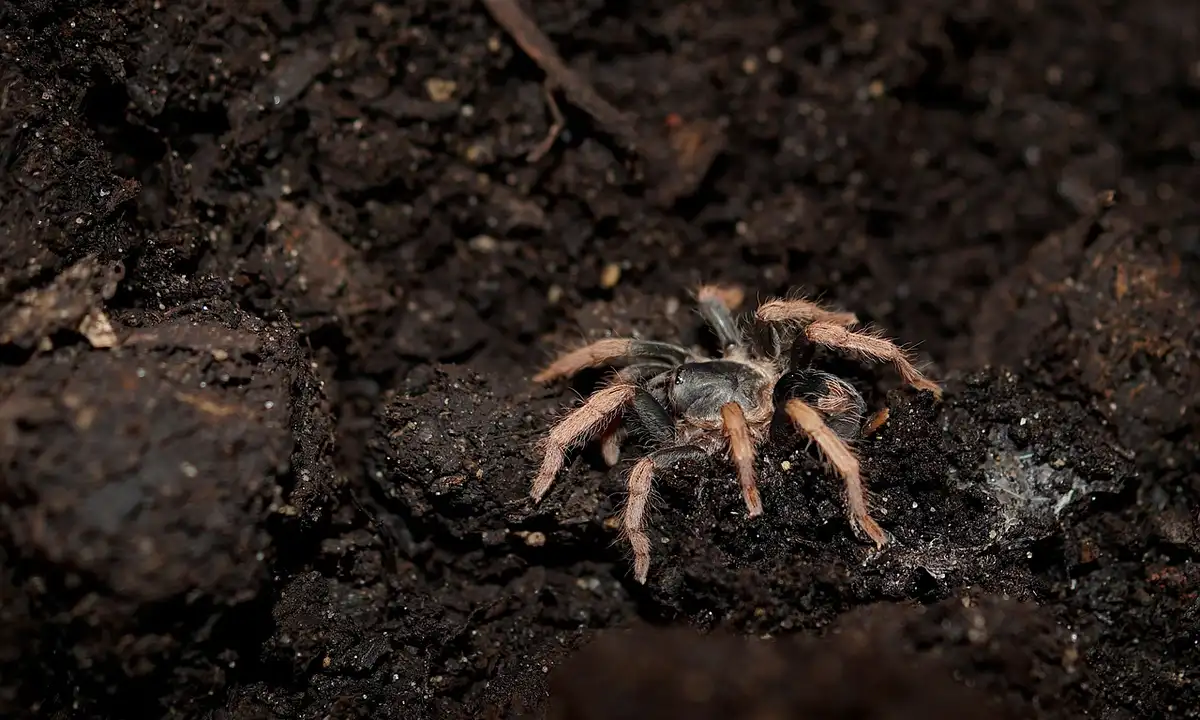
Recognizing that your tarantula is an aware, problem-solving animal directly transforms your approach to husbandry. You shift from keeping a simple pet to curating an environment for a sophisticated, albeit tiny, predator. This perspective makes you a more attentive and responsible keeper, focused on reducing stress and providing mental stimulation through habitat design. A tarantula species identification care guide helps tailor care to the exact species. It makes your attention practical by aligning habitat, humidity, and feeding with species-specific needs.
Respecting the “Why” Behind Behaviors
An irritated tarantula isn’t being “mean.” It’s communicating. My Burgundy Goliath Bird Eater, Goliath, frequently kicks urticating hairs when I service his enclosure. Viewing this through a cognitive lens, I see a calculated defense. He assesses the large disturbance (my hand), perceives a threat, and deploys a highly effective deterrent. This behavior isn’t random aggression; it’s a learned, predictable response to a specific stimulus, telling me I need to work slower and give him more cover. Are these common tarantula behaviors, and what do they mean? Exploring their meanings can guide safer handling and better welfare.
Enclosure Design as Cognitive Enrichment
A bare tank with a water dish and hide meets basic needs. An enriched enclosure supports natural cognition.
- Complex Terrain: Use cork bark, leaf litter, and sphagnum moss to create multiple pathways, nooks, and vantage points. This allows for patrolling and exploration, which is problem-solving in action.
- Anchor Points for Weavers: For species like my OBT, Flash, who web relentlessly, providing ample anchor points (sticks, branches, faux plants) is essential. The act of engineering a web-lined retreat is a profound expression of spatial intelligence and material manipulation.
- Substrate Depth for Diggers: A deep, packed substrate layer allows fossorial species to exercise their innate engineering skills, constructing stable burrows that require assessment of soil integrity and chamber design.
The Critical “Look, Don’t Touch” Policy
Handling is a massive, unpredictable problem you force your tarantula to solve. The only solutions in its repertoire are fleeing, threat postures, or a defensive bite. Regular handling chronically elevates stress, suppressing natural behaviors and potentially shortening the animal’s lifespan. The fascination comes from observation, not interaction. There’s a common myth that holding equals affection, but tarantulas don’t experience affection in the way mammals do. Real care is shown by minimizing handling and observing their natural behaviors from a respectful distance. Watching Rosie, my Chilean Rose Hair, methodically explore her territory after a cage cleaning is far more rewarding than holding her.
Observing Your Own Tarantula’s Cognition
You can conduct simple behavioral studies right at home. The key is silent, patient observation. Sit still for twenty minutes and just watch. You’ll start to see patterns emerge.
Documenting Problem-Solving Sequences
Keep a simple log. Note the time, stimulus, and your tarantula’s action sequence.
- The Scenario: A feeder cricket hides under the cork bark.
- The Observation: Does your tarantula (a) immediately give up, (b) wait motionless at the burrow entrance, or (c) actively reposition itself to ambush from a new angle?
- The Data: My OBT, Flash, consistently chooses (c). He will rapidly circle the obstacle to cut off the cricket’s escape, demonstrating advanced prey triangulation.
Personality Mapping Through Routine
Their individual “personality” is their unique set of cognitive biases and learned responses.
- The Cautious Strategist (like Rosie): Approaches all novel items (new water dish, misplaced tongs) with extreme, prolonged caution. May take days to re-establish a path after enclosure maintenance.
- The Bold Engineer (like Flash): Immediately investigates changes, often webbing over new objects within hours. Shows rapid habituation to non-threatening daily vibrations.
- The Defensive Specialist (like Goliath): Has a very low threshold for triggering defensive behaviors. This isn’t a flaw; it’s a highly conserved survival strategy for a large, conspicuous species in the wild.
By viewing your tarantula as a cognitive individual, you unlock a deeper layer of the hobby centered on respect and fascination for their innate brilliance. You start providing not just food and shelter, but an environment where their natural intelligence can be expressed. The reward is a more visibly content animal and the profound satisfaction of being a thoughtful steward of a fascinating life.
FAQs
How do tarantulas use their senses to navigate and hunt?
Tarantulas primarily use vibration and touch through specialized hairs (setae) to perceive their world. They detect the faintest movements of prey or threats through air currents and substrate vibrations. Chemical sensing via their legs and pedipalps helps them “taste” the air for pheromones or moisture, guiding them to resources or mates. This sensory system allows them to be effective ambush predators in their environment without relying on sharp eyesight.
What are the cognitive limitations of tarantulas compared to other arachnids like jumping spiders?
Tarantulas are specialists in patience and ambush, not complex active hunting or advanced problem-solving. Unlike jumping spiders, which can plan routes and show curiosity, tarantulas lack evidence for observational learning or navigating large, unfamiliar spaces. Their intelligence is narrowly focused on energy-efficient survival within a small, familiar territory. They are also profoundly asocial, with brains not wired for the cooperation or communication seen in some other spider species. So what’s the difference between tarantulas and other spiders? Other spiders often rely on web-based hunting, active tracking, or even social behaviors, while tarantulas rely on ambush, venom, and solitary strategy.
How does a tarantula’s web-building behavior demonstrate learning or problem-solving?
While the drive to spin silk is instinctual, the application can show spatial learning. A tarantula will modify its webbing based on the specific layout of its enclosure, creating efficient highways to funnel prey or reinforce escape routes. They remember the architecture of their web, using it as a vibration-transmitting map to locate disturbances quickly. This shows an ability to memorize and optimize their own structures within a learned environment.
How do researchers study and measure intelligence in tarantulas?
Scientists use controlled experiments, often involving simple mazes or obstacle courses, to test spatial learning and memory. They study habituation by measuring how long it takes for a defensive response to a repeated, non-threatening stimulus to diminish. Problem-solving is assessed through tasks like accessing hidden prey or navigating new terrain to reach a shelter. These studies focus on behaviors tied to core survival needs like foraging and predator avoidance.
What are the most surprising findings about tarantula cognition and behavior?
Key surprises include their capacity for habituation, where they can learn to ignore predictable, non-threatening disturbances. Research and keeper observations also show clear evidence of spatial memory, such as remembering the precise location of a water dish or the layout of a burrow system. Perhaps most intriguing is the clear display of individual “personalities” or behavioral biases, like boldness or caution, which suggests variation in how they interact with their world.
The Final Molt
The single most important environmental factor for encouraging a tarantula’s natural problem-solving behaviors is providing a habitat with complex structure and multiple anchor points. An enclosure that is both secure and spatially interesting—with cork bark to navigate, plants to incorporate, and substrate depth to manipulate—is the canvas upon which their cognitive abilities are expressed. A barren tank is a bored spider. In my tarantula enrichment guide, I show practical ways to translate this into engaging setups. Environmental enrichment is essential for preventing boredom in captive spiders.
Watch how your tarantula approaches its environment. Notice the deliberate placement of silk lines to detect vibrations, the methodical excavation of a burrow corner, or the patient recalibration of a hunting strategy after a missed strike. If your tarantula is a burrower, watching how it digs can illuminate its digging behavior and shelter-building instincts. This quiet observation is the reward. Progress in understanding these animals is measured in months and years, not days. Give them the tools, step back, and let their silent, intricate intelligence unfold.
Further Reading & Sources
- How Smart is a Tarantula? Discover 7 Surprising Facts | PDF
- How smart is a tarantula? – The Environmental Literacy Council
- Are Tarantulas intelligent? | Arachnoboards
Arlo is a lifelong arachnid enthusiast who believes tarantulas are the world’s most misunderstood roommates. With years of hands-on experience in tarantula care, habitat setup, and species behavior, Arlo combines expert knowledge with a dash of humor to make spider ownership less scary and a lot more fascinating. From choosing the right enclosure to understanding why your eight-legged buddy is doing that weird little pose again, Arlo is here to help you become the best tarantula parent you can be, without getting tangled in the web of misinformation.
Understanding Tarantula Behavior