
How to Read Your Tarantula’s Body Language (Stress and Defensive Signs)
Published on: February 22, 2026 | Last Updated: February 22, 2026
Written By: Arlo
Your tarantula’s enclosure is a silent theater where every subtle shift in posture tells a story of comfort, curiosity, or rising alarm. Unlike mammals, these arachnids communicate through an intricate, non-verbal language of stance and movement. Deciphering this language is the cornerstone of respectful “Look, Don’t Touch” husbandry, allowing you to preempt stress and avoid defensive encounters. From the slow, deliberate placidity of my old Chilean Rose Hair, Rosie, to the lightning-fast threat poses of my OBT, Flash, I’ve learned that reading these signs is not just observation-it’s essential communication.
- Quick Stats:
- Origin: A universal behavioral lexicon evolved across global habitats.
- Type: New World tarantulas (like my T. stirmi, Goliath) often lead with hair-flicking warnings; Old World species typically skip to rapid, venom-focused defense.
- Growth Rate: Core body language remains consistent, but defensive behaviors become more pronounced and faster as the tarantula matures from sling to adult.
This guide will translate the nuanced performances in your tarantula’s enclosure, giving you the tools to understand its needs and reduce stress throughout its entire life.
Why Tarantula Body Language is a Husbandry Essential
Observing your tarantula’s posture and movements is not a hobbyist luxury; it is the cornerstone of proactive, respectful care. These silent signals are your earliest warning system for environmental stress and underlying health issues. A sudden change in demeanor often precedes a molt, indicates discomfort with humidity or temperature, or signals a reaction to enclosure vibrations. By learning to read these subtle cues, you transition from a passive keeper to an attentive caregiver, capable of preventing problems before they escalate.
This knowledge directly improves welfare in several key ways:
- It allows you to identify and correct suboptimal enclosure conditions immediately.
- It minimizes handling stress, as you learn to recognize clear “do not disturb” signals.
- It helps you differentiate between normal species-specific behavior and genuine distress.
- It provides critical context during molting, rehousing, or feeding, making these processes safer for you and your tarantula.
Establishing the Calm Baseline: Normal Posture and Behavior
Before you can identify stress, you must first understand calm. A relaxed tarantula moves with deliberate, often slow, purpose. Its legs are typically folded comfortably beneath its body or extended in a natural, weight-bearing stance—not splayed flat or held rigidly high. You’ll see regular use of its hide for resting and periods of quiet, confident exploration, often at night. This baseline state of quietude is what we strive to maintain through consistent, proper husbandry. For complete beginners, this is a gentle introduction to tarantula care. Understanding calm provides the cornerstone for your beginner’s tarantula journey.
A stressed tarantula will deviate sharply from this established normal. The key is knowing what “normal” looks like for your specific spider, as it varies tremendously by species and even individual personality. Being attuned to early warning signs helps you tell when a tarantula is sick rather than merely stressed. Look for changes such as reduced appetite, lethargy, or unusual shedding as potential indicators.
Signs of a Content Tarantula
- Deliberate Walking: Movement is steady and controlled, not frantic or erratic.
- Relaxed Posture: Abdomen rests comfortably on the substrate, legs are bent at the joints, not locked straight.
- Normal Hide Use: It retreats to its shelter for daylight hours but emerges predictably in the evening.
- Confident Feeding: It strikes at prey readily and consumes it without excessive startle reactions.
- Calm Grooming: You may observe it meticulously cleaning its legs and pedipalps, a sign of a secure, undisturbed animal.
Individual and Species Norms
What is “calm” for one tarantula can look like stress for another. My Chilean Rose Hair, Rosie, defines baseline as a near-statue. She may not move from one spot for weeks, which is perfectly normal for her species. Contrast this with my Orange Babbling Tarantula (OBT), Flash. For Flash, normal involves frequent, lightning-fast webbing projects and a constant, vigilant awareness of his surroundings; his high energy is not a stress signal, but his species’ default setting.
My Burgundy Goliath, who enjoys high humidity, will often rest with his body lowered into the moist substrate. For a desert species, this same posture could indicate a desperate search for moisture. You must interpret body language through the lens of your tarantula’s natural history and unique personality. Learning their personal “dialect” of movement is the most rewarding part of arachnoculture.
Decoding Common Stress Signals in Your Arachnid
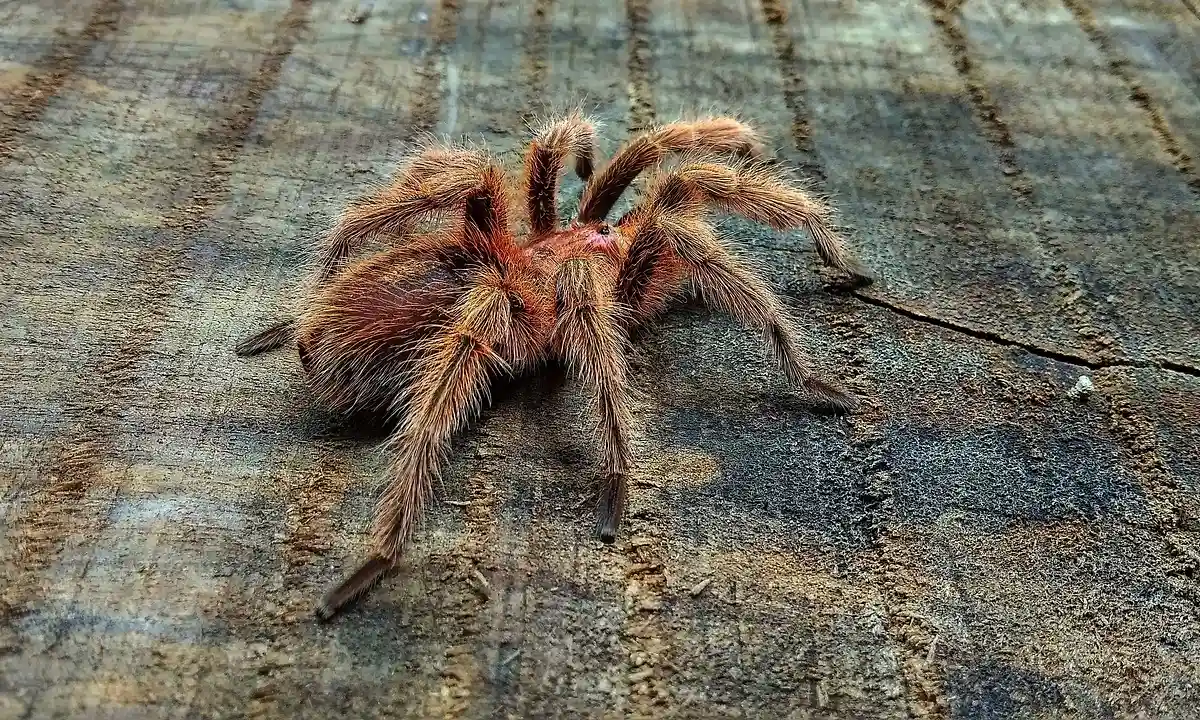
Your tarantula communicates volumes through subtle shifts in behavior and posture. Learning to interpret these quiet signals is the first step in becoming an attentive and responsible keeper. Stress signs often precede more dramatic defensive displays, giving you a chance to adjust their environment before they feel truly threatened. In feeding situations, tell if your tarantula is hungry or stressed with our feeding behavior guide. It helps you distinguish hunger cues from stress cues.
Hiding, Retreat, and Appetite Loss
A hiding tarantula is often a content tarantula, but the context is key. A frantic scramble for cover when you approach, or a prolonged, self-imposed isolation in an unnatural spot, indicates high anxiety. This can be triggered by excessive vibration, bright overhead lighting, or an enclosure that feels too open.
Appetite loss is a classic stress flag, but it requires careful interpretation. My Chilean Rose Hair, Rosie, famously refuses food for months on end, which is normal for her species’ slow metabolism. A sudden, prolonged fast in a typically hearty eater, however, paired with other signs like constant hiding, points to environmental stress or the early stages of pre-molt. Always rule out husbandry issues before assuming it’s a simple fast.
Agitated Movement and Leg Tapping
Calm, deliberate walking is normal. Stress movement is erratic and hurried. Watch for quick, jerky dashes across the enclosure or repeated, frantic attempts to climb the walls, often called “boxing.” This signals a desire to escape perceived danger.
Leg tapping is a more nuanced signal. A tarantula will rapidly drum its front legs on the substrate, testing vibrations and chemical cues. While partly sensory, intense or repeated tapping when you are nearby is a sign of irritation and a request for more space. I see this often during cage maintenance if I move too quickly.
Physical Changes: Color and Posture Shifts
A tarantula’s physique can telegraph internal state. A noticeably darkened, almost blackened abdomen can indicate prolonged stress or the onset of a health issue, distinct from the shiny darkening of a pre-molt tarantula.
Posture speaks loudly. A healthy tarantula at rest has its abdomen comfortably on the ground. A stressed individual may hunch its body, curling its legs tightly underneath and arching its back, making itself appear smaller and more guarded. This is a closed-off posture, the arachnid equivalent of turning away. It’s a quiet plea for less stimulation.
Interpreting Defensive Signs and Threat Displays
When subtle stress signals are ignored, a tarantula will escalate to clear defensive communication. These are unambiguous warnings you must heed for your safety and the animal’s wellbeing. This is the heart of the “Look, Don’t Touch” philosophy-respecting these boundaries prevents accidents and chronic stress.
The Threat Posture: Raised Legs and Exposed Fangs
This is the classic “back off” signal you cannot mistake. The tarantula rears up, lifting its first two pairs of legs and its pedipalps high, while tilting its body back to reveal the glossy, dark fangs. The abdomen lowers, anchoring the spider for a potential strike.
My OBT, Flash, assumes this posture if I even look at her enclosure sideways. This display is not aggression but a defensive bluff, a final warning before they feel forced to use their fangs. The correct response is to slowly retreat, dim lights, and give them space. Never try to handle a tarantula in a threat posture.
Urticating Hair Kicking and Leg Flicking
New World tarantulas like my Goliath possess a potent mechanical defense: defense with urticating hairs. When agitated, they will arch their abdomen and rapidly scrub their back legs against the specialized hair patches, launching a cloud of microscopic barbs. This defense is primarily mechanical, not venom-based; tarantulas rely on hairs to deter threats rather than venom. If forced to bite, they can inject venom, but the hair cloud itself is the main first line of defense.
You may see a “rear threat” pose first, where they present their abdomen toward the disturbance. These hairs cause severe itching and respiratory distress if inhaled, a serious risk during enclosure cleaning. Leg flicking, a milder version where they merely flick hairs off without a full kick, is a preliminary “stop that” cue. Always wear eye protection and a mask when working near a tarantula known to kick.
Rapid Strikes, Bites, and Defensive Retreats
A bite is always a last resort, a costly act of self-defense. A defensive strike is blindingly fast, often a downward slap with the fangs followed by an immediate retreat, unlike the deliberate, holding bite used for prey. They would much rather flee.
This brings us to the defensive retreat. A tarantula that bolts into its burrow or hide at high speed is communicating a clear preference: it wants to be left alone, now. Chasing or prodding them after such a retreat is how defensive bites happen. Respect the retreat. It is the best outcome for both of you. Some tarantulas also signal their intent with subtle postures and stridulation, or even faint leg taps in certain species. Understanding these cues can help you recognize when it’s time to back off and give them space.
How Species and Personality Influence Body Language
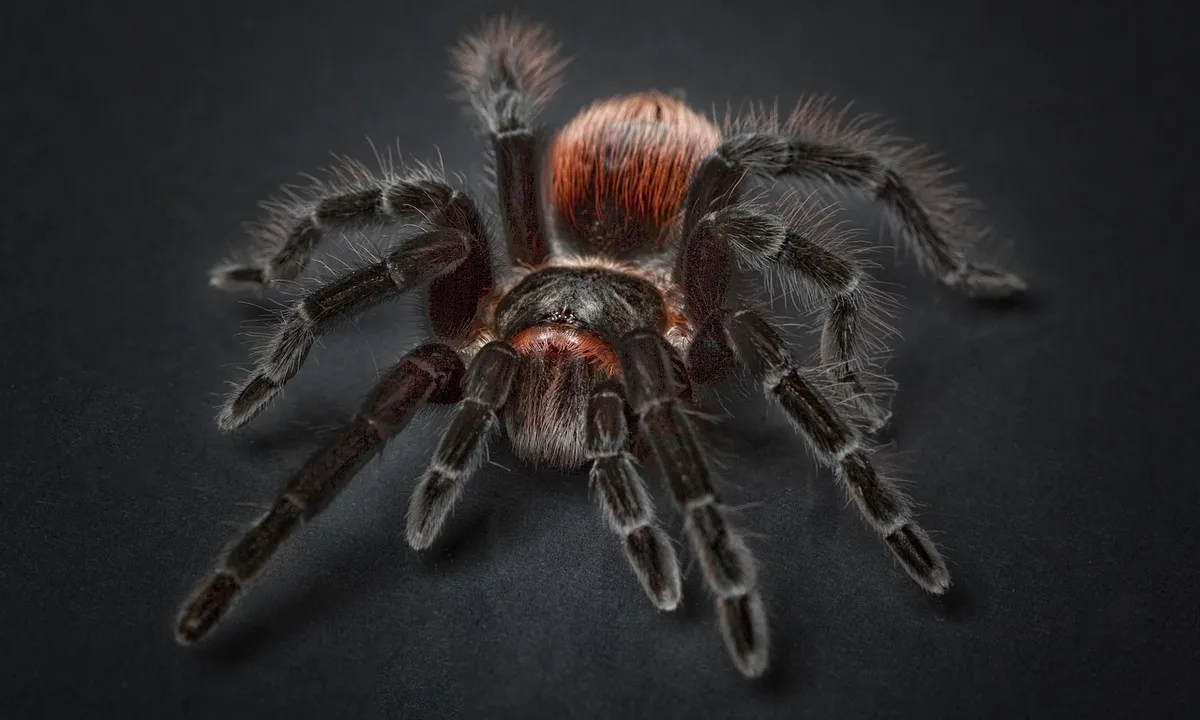
Your tarantula’s body language is not a universal code. It shifts dramatically with species and individual temperament. I keep three tarantulas with distinct personalities, and reading each one requires a completely different lens than just understanding their species-specific temperament.
Rosie, my 15-year-old Grammostola rosea, communicates through profound stillness and subtle shifts. Her dusty pink body might not move for months, making any change a significant event.
Goliath, my Theraphosa stirmi, uses his size and urticating hairs as a primary language. A raised abdomen is his clear, itchy warning before he kicks a cloud of defensive hairs.
Flash, my Pterinochilus murinus, speaks in bursts of orange motion and dense silk. His entire existence is a defensive posture, from his speed to his webbed fortress.
You must tailor your observations to the spider in front of you. Learning your tarantula’s unique baseline of normal behavior is the first and most critical step.
Docile and Slow-Moving Species (e.g., Grammostola)
Tarantulas like the Chilean Rose Hair are masters of subtlety. Their stress signs are easy to miss if you are not patient.
Prolonged, unusual inactivity is often the loudest signal a docile species will give. When my Rosie refused her hide for weeks, it was a silent plea for a substrate change.
- Watch for a slight, persistent tucking of legs tightly under the carapace.
- Note any avoidance of familiar spots, like their water dish or favorite corner.
- A defensive stance is rare but will be slow, with front legs lifted lethargically.
These species internalize stress. Their reactions are measured in millimeters and months, not seconds.
Defensive and Fast Species (e.g., Old World Tarantulas)
Old World tarantulas operate on a different neurological scale. Their body language is instantaneous and unambiguous. Are these common tarantula behaviors meaningful? What do they mean in terms of threat, curiosity, or comfort?
Flash’s bright orange coloration is a natural warning flag, matched by his lightning-fast threat display. He can shift from stillness to a full threat posture-fangs bared, abdomen high-in the blink of an eye.
- They often choose confrontation or flight over hiding. A rapid, sideways scuttle is a common pre-strike movement.
- Excessive webbing, especially over the enclosure entrance, is a defensive barricade.
- Their speed means a threat can become a strike or an escape attempt before you react.
With these species, you must decode their language from a respectful distance; close proximity is itself a provocation.
Practical Steps to Reduce Stress and Defensiveness
Interpreting body language has one goal: to reduce your tarantula’s stress. Creating a low-stress environment is the most respectful care you can provide.
Your actions should always favor the animal’s peace over your convenience. This philosophy turns reactive worry into proactive, calm husbandry.
Immediate Response to Stress or Threat Displays
When your tarantula signals distress, your response must be swift and passive. Follow these steps in order.
- Cease all interaction immediately. Halt feeding, cleaning, or any movement near the enclosure.
- Dim room lights or drape a light cloth over part of the enclosure. This simulates a sudden, safe retreat.
- Do not attempt handling or prodding. This is a non-negotiable “Look, Don’t Touch” rule for safety.
- Allow for extended quiet, from several hours to multiple days. Only return for critical needs like replenishing water.
I apply this protocol every time Goliath flicks his urticating hairs, giving him the solitude he needs to calm down.
Optimizing the Enclosure to Minimize Stress
Long-term comfort comes from a perfected habitat. A proper enclosure addresses instinctual needs before stress arises.
Begin with a hide that allows for complete darkness and tight security. My T. stirmi’s hide is a cork bark tube he can cram his entire body into, which he loves.
- Humidity and temperature: Use digital gauges. Goliath needs 75-85% humidity, Flash prefers 70-80°F with moderate moisture, and Rosie thrives in arid conditions below 70%.
- Substrate choice: Moisture-retentive coconut fiber or topsoil blends are vital for burrowers like Goliath. Provide depth equal to at least 1.5 times their leg span.
- Bioactive setups: Introducing clean-up crews like springtails creates a stable micro-environment. This natural system breaks down waste and reduces your disruptive cleaning visits.
- Lighting sensitivity: Tarantulas are photophobic. Use ambient room light or very dim, indirect LEDs. Never place an enclosure in direct sunlight.
Make one adjustment at a time and observe for a full week; stability is the ultimate predictor of a tarantula’s contentment.
Special Contexts: Molt Anxiety and Health-Related Behaviors
Beyond daily stress, two situations demand your sharpest observation: the vulnerable molting period and potential health declines. A tarantula’s behavior here is a direct broadcast of its internal state.
Molt anxiety is a very real state of heightened vulnerability, and your pet’s actions will shift from defensive to purely self-preservative.
Recognizing Pre-Molt and Post-Molt Cues
In the weeks before a molt, your tarantula is undergoing a profound biological transformation. Its old exoskeleton separates, and a new one forms beneath. This process dictates a new set of behaviors. During molts, tarantulas can regrow lost legs during molts as a new limb forms beneath the old shell and then extends once the molt completes. The regrowth continues across subsequent molts until the limb reaches its full size and strength.
- Lethargy and Seclusion: An active burrower like my OBT, Flash, may seal its retreat. An open-air species will often choose a quiet corner and become statue-still. My old G. rosea, Rosie, turns into even more of a ‘pet rock’.
- The Darkening Abdomen: The skin on the abdomen, or opisthosoma, will darken to a near black or deep blue. This is the new exoskeleton visible underneath.
- Refusal of Food: This is non-negotiable. As the mouthparts detach, eating is impossible. Attempting to feed a tarantula in pre-molt can cause fatal injury.
- Web Cradle Construction: Many species, especially arboreals, spin a thick, silken mat. This isn’t decoration; it’s a safety net for the delicate molting process.
- The Ultimate Sign: Laying on Its Back. Do not panic. This is not a death curl. The tarantula has positioned itself to push free of the old skin. The enclosure must be absolutely undisturbed.
Your care shifts now. Increase humidity slightly to ease the shed, but do not flood the enclosure. Provide total privacy-no poking, no feeding, no light disturbances. The silence of the enclosure during a molt is a tense, sacred thing.
When Behavior Signals a Health Issue
Not all odd postures are stress or molt-related. Some point toward injury, dehydration, or systemic illness. Chronicity is your clue.
A stress pose is temporary; a health-related behavior is persistent and often accompanied by a decline in condition.
- Prolonged “Death Curl”: Legs tucked tightly, irreversibly underneath the body for hours or days. This signals severe weakness, often from dehydration or injury.
- Chronic Imbalance or Tipping: A healthy tarantula rarely falls. Consistent clumsiness can indicate neurological damage, often from a bad molt or a fall.
- Odd Limb Positioning: A leg held aloft and never placed down, or dragged awkwardly, suggests damage. I once had a juvenile who dragged a leg after a mismolt; it was successfully autotomized and regenerated.
- Prolonged Abdominal Sprawl: While some species like my T. stirmi, Goliath, naturally sprawl, a sudden, limp flattening of the abdomen against the substrate can be a sign of distress.
- Constant, Aimless Pacing: Different from cage exploration, this is a frantic, repetitive circuit. It can signal an unsuitable environment or an underlying health irritation.
If you observe these behaviors, first cross-check your husbandry-temperature, humidity, water availability. If parameters are perfect and the behavior persists, consult a veterinarian specializing in invertebrates. Journaling your tarantula’s normal rhythms makes spotting these dangerous anomalies immediately obvious. Proactive care helps prevent common tarantula health problems. Regular observation and timely care keep tarantulas thriving.
## FAQs
Can my tarantula’s body language tell me if it’s “happy” or likes me?
Tarantulas do not experience emotions like happiness or affection in the way mammals do. Their body language primarily communicates states of comfort, stress, or defense. A “content” tarantula is simply one that feels secure and unchallenged in its environment, exhibiting calm, baseline behaviors. Interpreting their signals is about ensuring their welfare, not building a reciprocal bond.
Why does my tarantula kick hairs when no one is bothering it?
Urticating hair kicking can be a reaction to perceived environmental threats, not just direct interaction. Vibrations from household appliances, bright lights, or even shadows passing over the enclosure can trigger this defensive behavior. Some individuals may also kick hairs to prepare their burrow or web, using the irritating fibers as a deterrent against pests. Observing when it happens can help you identify and eliminate unseen stressors in its space.
How can I tell the difference between pre-molt lethargy and stress-related hiding?
Pre-molt is accompanied by specific physical cues like a dark, shiny abdomen and a loss of appetite in a previously good eater. The tarantula will often seal itself off or create a molting mat. Stress-related hiding is typically more frantic and reactive to external stimuli, lacks these physical pre-molt signs, and may be paired with other stress signals like leg tapping. Context and observation over time are key to distinguishing between the two.
What should I do first if I notice my tarantula showing stress signals?
Your immediate action should be to stop all interaction and reduce environmental stimulation. Step away, ensure the room is quiet, and consider dimming the lights. Assess the enclosure fundamentals from a distance-check temperature, humidity, and ensure the water dish is full. Only after a period of quiet (24-48 hours) should you gently investigate potential causes, such as an overly open enclosure or irritating vibrations.
My tarantula often assumes a threat pose during maintenance. Does this mean it’s aggressive?
No, a threat pose is a defensive display, not a sign of aggression. It is a clear, honest communication meaning “you are too close, and I feel threatened.” This is especially common in fast, defensive species like Old World tarantulas. The best practice is to heed the warning, pause your activity, and allow the animal to calm down before proceeding slowly or rescheduling the task for later.
Long-Term Success
The single most important parameter for a healthy tarantula is an environment that minimizes stress, built through correct humidity, ample substrate, and silent observation. Every sign we’ve discussed—from a threat pose to frantic climbing—stems from an animal perceiving a threat it cannot escape. Being able to recognize common signs your tarantula is stressed or defensive helps you respond promptly and adjust conditions. Typical signals of stress or aggression include a threat pose, leg flicking, rapid changes in posture, or defensive retreats. Your primary job is to be the architect of a secure, species-appropriate world.
Beyond reading stress, learn to read contentment. Watch for the meticulous webbing of an OBT like my Flash, who turns his enclosure into a silken fortress. Appreciate the patient, silent ambush of a rose hair like Rosie, who has taught me more about stillness than any other pet. The deepest joy in this hobby comes not from interaction, but from witnessing the complete, unperturbed expression of natural behavior in an animal that feels truly safe. Your patience is the ultimate key to their wellbeing.
Further Reading & Sources
- What Different Tarantula Stances Mean | Pets on Mom.com
- Posture / Body language | Arachnoboards
- Decode Your Tarantula’s Body Language In ONE Easy Step (IMAGE) – Tarantula Heaven
Arlo is a lifelong arachnid enthusiast who believes tarantulas are the world’s most misunderstood roommates. With years of hands-on experience in tarantula care, habitat setup, and species behavior, Arlo combines expert knowledge with a dash of humor to make spider ownership less scary and a lot more fascinating. From choosing the right enclosure to understanding why your eight-legged buddy is doing that weird little pose again, Arlo is here to help you become the best tarantula parent you can be, without getting tangled in the web of misinformation.
Understanding Tarantula Behavior